
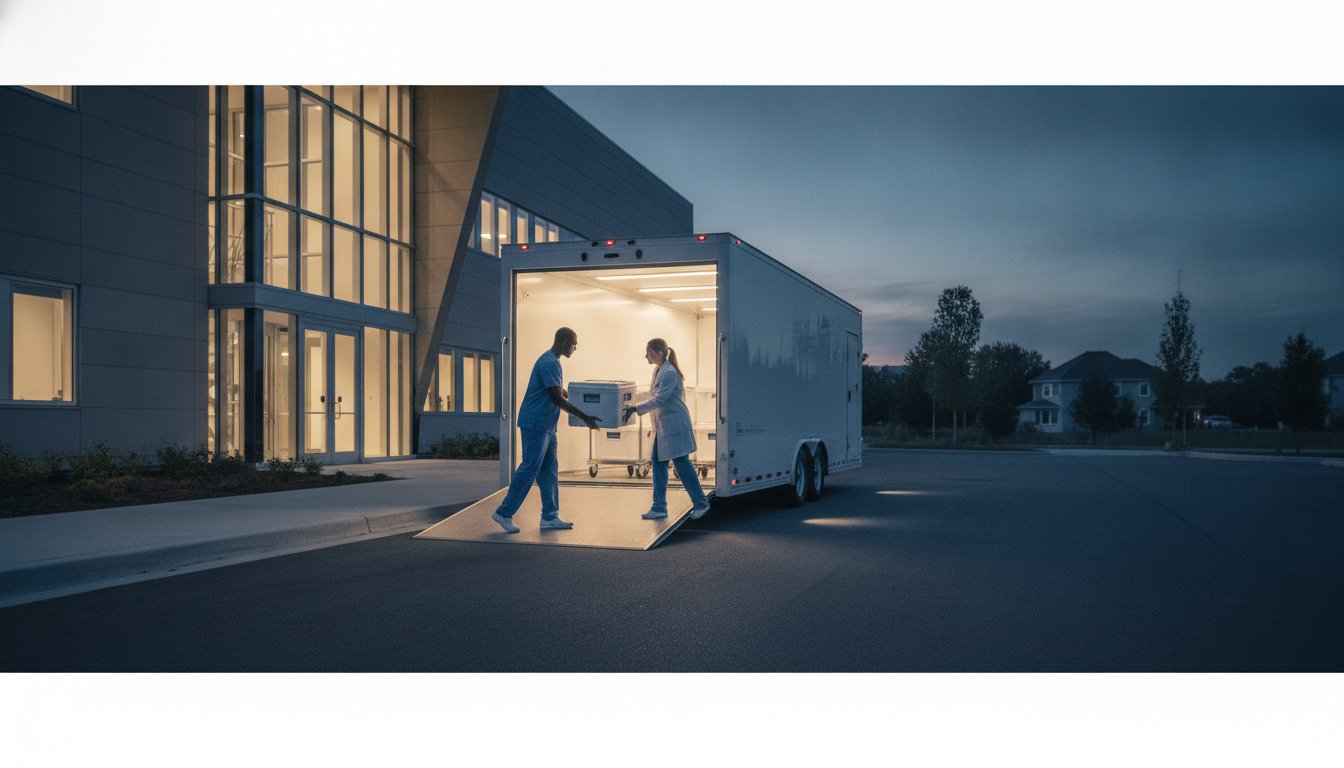
Did you know the pharmaceutical industry loses an estimated $35 billion every year due to cold chain failures? When your facility’s cooling system crashes, you aren’t just losing inventory. You’re risking a multi-million dollar disaster and a brutal FDA audit. It’s a high-stakes crisis that demands an immediate, professional solution. That’s why securing a reliable disaster relief cold storage rental is the only way to protect your patients and your bottom line.
You need to know that your medical supplies are safe, even when the power is out or the main cooler is down. We understand the pressure of maintaining 100% cold chain integrity under the 2026 FDA Quality Management System Regulation. This article will show you how ground-level refrigerated trailers provide the speed and precision required for strict compliance. We’ll explore rapid-response strategies, the importance of local 24/7 support, and how to transition seamlessly during facility repairs without losing a single dose.
Key Takeaways
- Learn how to avoid multi-million dollar inventory losses by mastering the critical 2°C to 8°C temperature range for pharmaceuticals.
- Discover why ground-level trailer access is a game-changer for staff safety and clinical efficiency during a high-stakes emergency.
- Secure your facility’s compliance with 2026 FDA standards by integrating a disaster relief cold storage rental into your contingency plan.
- Simplify your logistics with mobile units that run on standard 110v power, allowing for immediate setup in any hospital parking lot or clinic space.
- Find out how 24/7 local experts can reach your Kansas City, Overland Park, or Olathe facility in minutes to save your high-value inventory.
Why Disaster Relief Cold Storage is a Necessity for Kansas City Healthcare
A single HVAC failure in a Kansas City hospital isn’t just an inconvenience. It’s a financial catastrophe. When the temperature spikes, millions of dollars in life-saving medicine start ticking toward expiration. Standard event coolers might keep drinks cold at a party, but they lack the precision required for medical inventory. You need a dedicated disaster relief cold storage rental that understands the high stakes of clinical preservation.
Kansas City faces unique threats. Severe weather like tornadoes can shred local power grids in seconds. Aging infrastructure leads to sudden HVAC breakdowns during the humid Missouri summers. In these moments, you don’t have hours to wait for a national chain to ship a unit from three states away. You need local, ground-level trailers that can be positioned and powered up immediately to maintain cold chain integrity. This speed is what saves inventory and protects public health.
Protecting High-Value Pharmaceutical Inventory
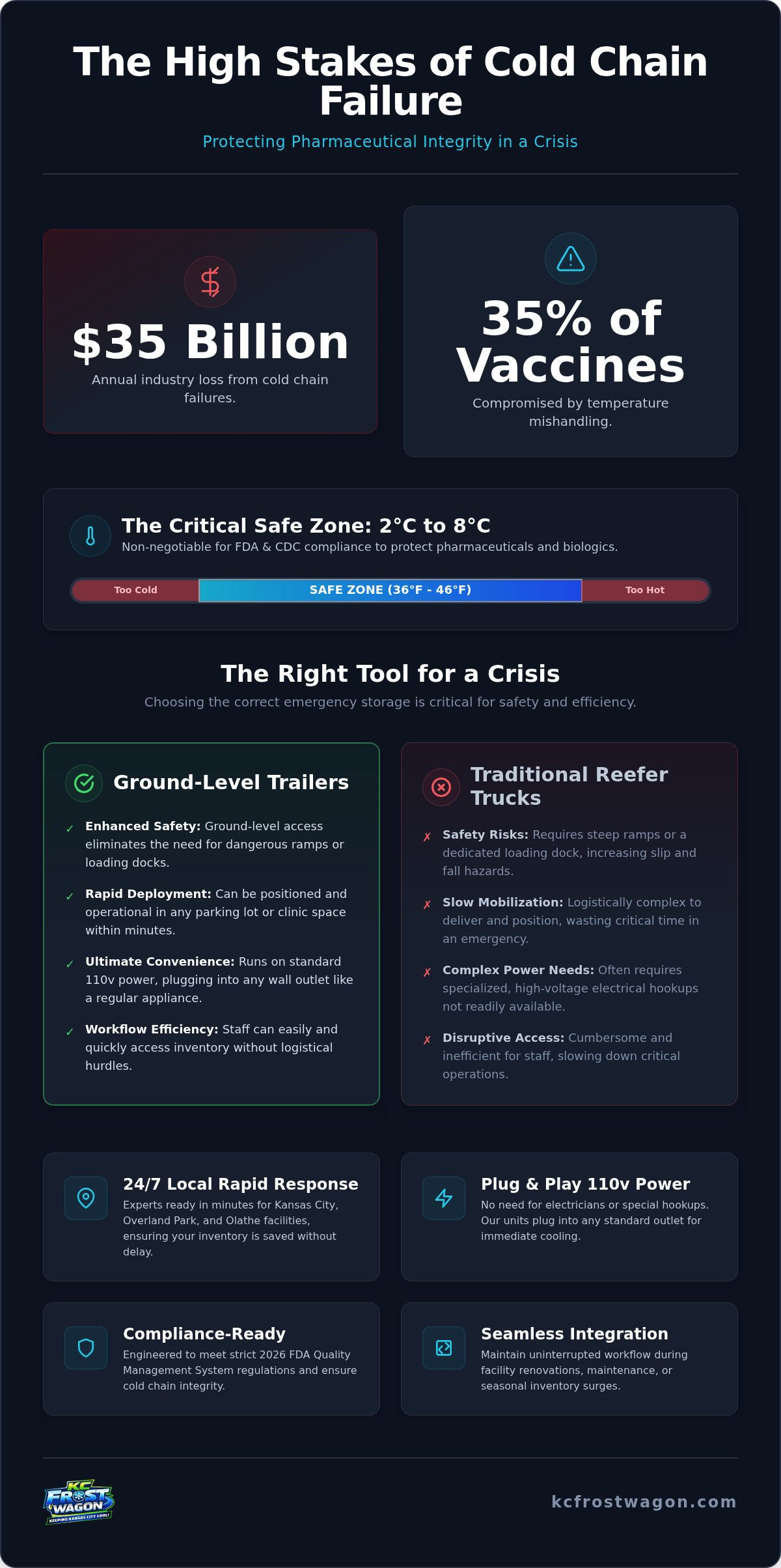
Pharmaceutical losses are staggering. The industry loses roughly $35 billion annually to cold chain failures. Research indicates that up to 35% of vaccines are compromised by temperature mishandling. Vaccines, biologics, and clinical samples are incredibly sensitive. A few degrees of variance can render them useless. Securing an emergency refrigeration rental acts as a vital insurance policy for your facility. It prevents the spoilage of high-value inventory and protects your reputation. Beyond the lost product, consider the hidden costs. You face potential CDC non-compliance, lost research hours, and the massive logistical headache of replacing specialized medicine.
Supporting Hospital and Lab Renovations
Emergency storage isn’t just for disasters. It’s for progress. When you update your facility, you shouldn’t have to halt your workflow. Our 6’x16’ units serve as a seamless bridge during scheduled maintenance or full-scale renovations. Choosing a professional disaster relief cold storage rental allows you to keep inventory accessible on-site. You won’t have to move delicate samples to a distant third-party warehouse.
- Maintain clinical workflow without interruption.
- Scale storage capacity for seasonal vaccine surges.
- Provide dedicated space for specialized clinical trials.
Ground-level access ensures your team stays safe and efficient. Your staff shouldn’t have to navigate steep ramps or loading docks during a crisis. We bring the storage to you. This ensures a smooth transition while your primary systems are serviced, keeping your focus on patient care rather than logistics.
Maintaining Cold Chain Integrity: CDC Compliance and Temperature Precision
The medical cold chain is more than just a refrigerator. It is a seamless, temperature-controlled path that protects a product from the moment it leaves the laboratory until it reaches the patient. In a crisis, this path is easily broken. A disaster relief cold storage rental must do more than just “stay cold.” It must provide the precision required to meet strict 2026 FDA Quality Management System Regulations and international ISO 13485:2016 standards.
Precision matters because most pharmaceuticals and biologics live in a narrow window. They require a constant temperature between 2°C and 8°C (36°F and 46°F). Standard cooling units often drift outside these lines, causing irreparable damage. Medical-grade refrigeration is built for stability. It uses advanced compressors and specialized seals to prevent the thermal spikes that ruin vaccines. If your inventory drops to -20°C or climbs to 10°C for even a short period, you might be looking at a total loss. Portable units designed for medical use bridge this gap by offering the same reliability as your facility’s permanent walk-in.
Temperature Consistency and Recovery
Clinical environments are busy. Staff constantly open and close doors to retrieve samples or vaccines. Each time that door opens, cold air escapes. High-grade insulation in our 6×16 freezer trailers is engineered to trap the cold and minimize these fluctuations. Fast temperature recovery is vital because it ensures the unit returns to its set point within seconds, not minutes. Thermal stability refers to the ability of a storage environment to resist temperature fluctuations despite external environmental changes or internal activity.
Monitoring and Compliance Reporting
Compliance isn’t just about what the thermometer says right now. It’s about what it said at 3:00 AM. CDC guidelines require the use of Digital Data Loggers (DDLs) with buffered probes for continuous monitoring. These devices provide an audit-ready trail of every minute of storage. When using a disaster relief cold storage rental, you can easily integrate external loggers to maintain your facility’s existing reporting standards.
- Set up multi-point alerts to notify your team of temperature excursions instantly.
- Utilize 24/7 service support to address equipment issues before they become disasters.
- Ensure your temporary storage meets the same traceability requirements as your main lab.
Don’t leave your compliance to chance during an emergency. You can explore reliable portable refrigeration options that keep your inventory safe and your audits clean.
Ground-Level Trailers vs. Reefer Trucks: The Best Choice for Disaster Relief
When a crisis hits, you need storage that works with your staff, not against them. Large reefer trucks are the standard for bulk shipping, but they’re often a nightmare for medical disaster relief. They sit high off the ground. They require loading docks or steep, slippery ramps. For a nurse or lab tech, this is a safety hazard. A disaster relief cold storage rental that sits at ground level removes these barriers. It keeps your team safe and your inventory secure.
Space is another critical factor. A semi-trailer needs a massive footprint and a dedicated loading bay. Most clinics and hospitals don’t have that luxury during an emergency. Ground-level trailers fit into standard parking stalls. They tuck away near side entrances, keeping the main flow of traffic clear. Plus, they run on clean electric power. You won’t have to deal with the constant roar and exhaust of a diesel engine right outside a patient’s window. It’s a quieter, more professional solution for sensitive environments.
Ease of Access for Clinical and Lab Staff
Safety is non-negotiable in a medical setting. Every time a staff member climbs a ramp with a tray of delicate samples, the risk of a drop increases. Our 6×16′ Cooler/Freezer Trailer eliminates that danger. It sits flat on the pavement. You walk right in, just like a standard indoor unit. This fits perfectly into existing medical workflows. There’s no need for forklifts or specialized training. You just open the door and get to work. By keeping the floor level, you significantly reduce the risk of inventory damage during the loading process.
Operational Cost and Setup Speed
Speed saves inventory. A reefer truck can take hours to position and stabilize. A portable trailer is operational almost immediately. When you compare daily rates, trailers often come out ahead because they don’t have the heavy overhead of a commercial truck. You also avoid the hidden costs of diesel fuel. In a disaster zone, fuel is often scarce and expensive. Electric-powered units plug into your facility’s existing power, saving you money and logistical stress. It’s a faster, quieter, and more efficient way to protect your assets without the technical baggage of a freight truck.
- Eliminate the need for expensive loading dock access.
- Reduce noise pollution in residential or patient zones.
- Plug directly into standard power sources for 24/7 reliability.
Choosing the right hardware is about more than just temperature. It’s about how that equipment integrates into your daily operations. Don’t let a logistical mismatch slow down your emergency response. A ground-level trailer provides the accessibility your clinical team needs to do their jobs safely and effectively.
Crisis Logistics: Powering and Securing Your Temporary Medical Storage
Logistics can make or break your emergency response. You’ve secured your disaster relief cold storage rental, but where does it go? Placement isn’t just about parking. It’s about accessibility and airflow. You need a spot with clear ventilation for the cooling unit and easy pathing for your staff. Before you move a single vial, run a pre-cooling protocol. Let the unit reach the set temperature and stabilize. This prevents a “warm load” from spiking the internal temp and triggering alarms.
Security is another non-negotiable. Medical inventory often carries a multi-million dollar price tag. Our units feature heavy-duty locking mechanisms to deter theft. For added peace of mind, GPS tracking allows you to monitor the unit’s location in real-time. It’s about protecting your assets from every angle. You can’t afford a security breach when lives are on the line.
Electrical Reliability in Disaster Zones
Power is the lifeblood of your cold chain. Most of our trailers run on standard 110v/20amp circuits. This is a huge advantage. You don’t need specialized high-voltage hookups or expensive electrical overhauls. However, you must ensure a dedicated circuit. Sharing a breaker with other medical equipment is a recipe for a trip. Use hospital-grade, weatherproof extension cords to maintain a steady flow of electricity. If the grid is down, these units integrate easily with portable generators. Always have a backup power plan ready before the storm hits.
Inventory Organization and Airflow Best Practices
How you pack your portable freezer rental determines how well it performs. Air must circulate freely to maintain a uniform temperature. If the air stops moving, the temperature starts climbing.
- Use wire shelving to allow air to flow under and around boxes.
- Keep inventory at least 6 inches away from the walls and ceiling.
- Never overpack the unit. A stuffed trailer creates “hot spots” where air can’t reach.
- Maintain a clear path to the internal sensors for accurate monitoring.
Overpacking is a common mistake. It blocks the return air vents and forces the compressor to work twice as hard. By following these airflow best practices, you ensure your sensors provide an accurate reading of the entire space. This prevents temperature excursions and keeps your inventory within the required range. Ready to secure your facility? You can reserve your emergency unit today to ensure your logistics are handled by experts.
24/7 Rapid Response: Your Local Partner for Medical Refrigeration Emergencies
When minutes decide the fate of your medical inventory, “national” often means “too slow.” National rental chains might promise delivery in 24 to 48 hours. In the medical world, that’s a lifetime. We operate differently. We are your neighbors. We are the local hero that arrives before the crisis peaks. Our disaster relief cold storage rental service is built on immediate action and local accountability. We are minutes away from Overland Park, Olathe, and the entire Kansas City metro.
Local expertise matters because we know the KC healthcare landscape. We understand the specific traffic patterns of I-435 and the power grid vulnerabilities of our local neighborhoods. When you call us, you aren’t reaching a call center in another time zone. You’re talking to a “Ready-for-Anything Expert” who can be on-site while others are still processing your paperwork. We handle the heavy lifting, the delivery, and the technical setup so you can stay focused on your patients.
Serving the Kansas City Healthcare Community
Our fleet is strategically positioned to support facilities across the region. Whether you’re managing a lab in Lee’s Summit, Independence, or Blue Springs, we have the equipment ready to roll. We provide critical emergency backup for clinics in Liberty, Gladstone, and even up to St. Joseph. Speed is the ultimate compliance tool. Why cold storage solutions for business must be local in a crisis comes down to one word: reliability. You can’t maintain a cold chain if your backup unit is stuck on a semi-truck three states away.
Booking Your Disaster Relief Trailer Rental
We’ve stripped away the corporate red tape to ensure a fast, seamless experience. Our 3-step process gets you back to work immediately. First, you make the emergency call to our 24/7 line. Second, we dispatch a 6’x12’ or 6’x16’ unit directly to your facility entrance. Third, we handle the full setup, including leveling and power verification. We offer the flexibility you need for any scenario. This includes 24-hour emergency saves or long-term rentals during hospital renovations.
- 24/7 local support for every rental unit.
- Ground-level trailers that bypass the need for loading docks.
- Rapid deployment to all major KC metro healthcare hubs.
Don’t wait for a system failure to find your partner. Secure a disaster relief cold storage rental that treats your inventory with the same urgency you do. Contact the KC Frost Wagon team now for an immediate response and total peace of mind.
Build a Resilient Cold Chain Strategy Today
Maintaining the integrity of your medical inventory requires more than a simple backup plan. It demands precision, speed, and local accountability. We’ve discussed how the 2°C to 8°C range is non-negotiable for 2026 compliance and why ground-level units outperform high-dock reefer trucks in clinical settings. A sudden equipment failure shouldn’t lead to a multi-million dollar inventory loss or a failed audit. Securing a professional disaster relief cold storage rental ensures your facility remains operational no matter what the Kansas City weather throws your way.
Our team provides 24/7 rapid emergency response across the entire KC Metro area, offering ground-level access for staff safety and seamless logistics. We take the burden of refrigeration off your shoulders so you can focus entirely on patient care. You’ve worked hard to build your inventory; let us help you protect it. Take the first step toward total peace of mind today by partnering with a local expert who understands your stakes.
Protect Your Inventory with a 24/7 Disaster Relief Quote. You’ve got this, and we’re just a phone call away whenever you need us.
Frequently Asked Questions
Can your trailers maintain the -10°F required for certain medical samples?
Yes, our units are designed to function as both coolers and deep freezers. The 6’x16’ trailers are built to reach and hold the sub-zero temperatures required for sensitive medical samples and laboratory research. Because they feature high-grade insulation and precision compressors, they maintain a steady environment even in extreme Missouri heat. We recommend discussing your specific temperature floor requirements with our team during the booking process to ensure total compliance.
How quickly can you deliver a refrigerated trailer to a hospital in Kansas City?
We prioritize emergency medical requests with our 24/7 rapid response service. Because we are locally based, we can typically deliver a disaster relief cold storage rental to major hubs like Overland Park, Olathe, or downtown Kansas City within hours of your call. Our team handles the delivery and immediate on-site setup. This speed is critical for preventing the spoilage of high-value pharmaceuticals when your primary cooling system fails.
What power source is required for a medical supply trailer rental?
Our mobile units are designed for maximum compatibility and run on standard 110v/20amp dedicated circuits. You don’t need to hire an electrician for specialized high-voltage hookups during a crisis. We provide hospital-grade, weatherproof extension cords to ensure a stable connection. If your facility loses grid power, these trailers are also compatible with most portable generators, making them a reliable choice for off-grid disaster relief scenarios in the KC metro.
Are the trailers secure enough to store high-value pharmaceuticals overnight?
Security is a top priority when handling inventory worth millions of dollars. Every trailer is equipped with heavy-duty locking mechanisms on the doors to prevent unauthorized access. We also utilize GPS tracking on our fleet to monitor the unit’s location at all times. This dual-layer approach provides the peace of mind necessary for storing sensitive pharmaceuticals on clinic grounds or in hospital parking lots during a multi-day emergency or renovation.
Do you provide temperature monitoring logs for FDA compliance?
While our units feature external temperature displays for quick checks, we encourage medical clients to integrate their own Digital Data Loggers (DDLs) for official compliance. Our trailers are designed to accommodate the buffered probes and external monitoring systems required for strict 2026 FDA and CDC audits. This allows you to maintain the same traceability and reporting standards you use for your permanent walk-in coolers and freezers without interruption.
What happens if there is a power outage at our facility while using the trailer?
If your facility loses power, the trailer will shut down unless it’s connected to a backup source. However, the high-grade insulation in our 6’x16’ units provides a thermal buffer that helps maintain internal temperatures for a limited time. For critical medical inventory, we recommend having a generator on-site. Our team can help you coordinate the electrical requirements to ensure your disaster relief cold storage rental stays powered during a grid failure.
Can your 6×16′ units be used as both a cooler and a freezer?
Yes, our 6’x16’ trailers offer versatile temperature controls that allow them to function as either a cooler or a freezer. You can set the unit to the standard 2°C to 8°C range for vaccines or drop it to sub-zero temperatures for frozen lab samples. This flexibility is essential for medical facilities that manage various types of biologics. You simply adjust the digital thermostat to match your inventory’s specific storage requirements.
Do you offer long-term rentals for medical facility renovations?
We provide flexible rental terms that range from 24-hour emergency saves to several months for facility renovations. Our 6’x16’ trailers are frequently used as temporary walk-in units during HVAC upgrades or lab expansions in Lee’s Summit and Independence. We handle the long-term maintenance and support, allowing your clinical staff to focus on patient care without the logistical burden of moving sensitive inventory to an expensive off-site warehouse.

