
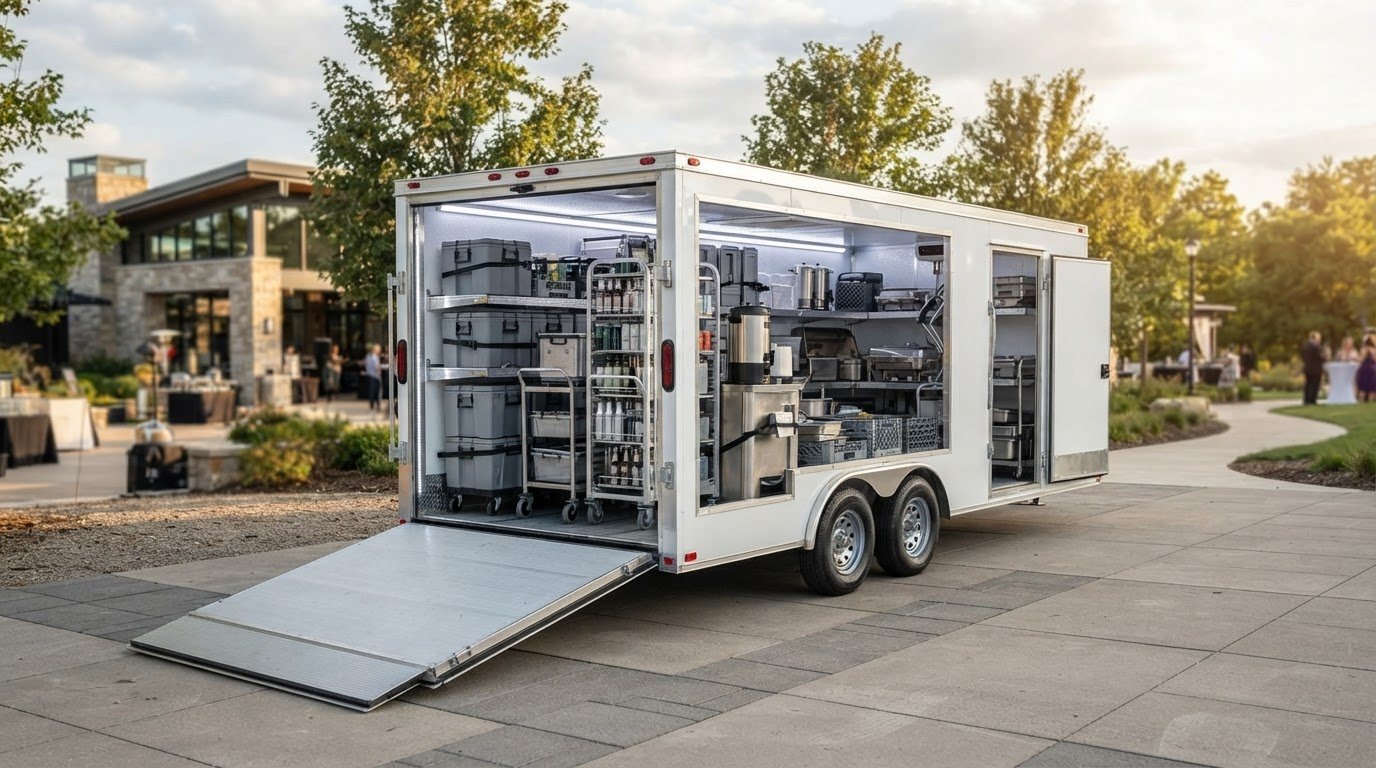
Floor space alone doesn’t tell you what will fit. A 6×12 cooler trailer has a nominal six-foot-by-twelve-foot size, but that doesn’t guarantee the same clear interior dimensions. How much fits in a 6×12 cooler trailer depends on usable space, cargo shape, loading access, and payload.
Planning a busy service or event means keeping products cold while making every trip count. The size can accommodate a range of cargo, but bulky appliances and tightly packed loads bring weight and maneuvering into the equation.
This guide explains what cargo and appliances can fit, how ramp and side-door access affects loading, and why payload matters as much as floor area. You’ll get a clearer way to assess your load and decide whether a 6×12 trailer suits the job or a larger size makes more sense.
Key Takeaways
- Use clear interior measurements, not just the advertised size, to judge whether bulky cargo will fit.
- Match trailer size to the shape and loading needs of your cargo, leaving room to maneuver and secure it.
- Ramp and side-door access can affect how easily appliances and other large items get in and out.
- Compare the trailer’s loaded rating with its empty weight; floor space alone doesn’t determine how much you can carry.
- For refrigerated storage in the Kansas City metro and nearby cities, KC Frost Wagon offers 12×6 and 16×6 cooler/freezer refrigerated trailers.
What Fits Inside a 6×12 Enclosed Trailer?
A 6×12 enclosed trailer’s nominal size gives a starting point, not an exact cargo capacity. Clear dimensions and interior equipment determine usable space, especially in a refrigerated unit.
Advertised and Usable Interior Dimensions
Advertised dimensions may not match the clear space available inside a trailer. That difference matters when planning for shelves, carts, or containers that must pass through the entrance.
A standard 6×12 enclosed trailer is described as six feet wide and twelve feet long, but its interior may be smaller. A U-Haul 6×12 is a specific model, so use its own interior measurements rather than assuming every trailer has identical clearance. Insulation thickness, wall shape, and refrigeration equipment also affect usable capacity. The trailer make and the placement of its refrigeration unit help determine how much space remains for cargo.
Width and Height for Cargo
Usable interior width is the clear distance available for cargo after accounting for walls and equipment. Measure wheeled items at their widest point, including tires and handles, and compare the measurement with both the doorway and the floor. A cart that clears the entrance still needs room inside without blocking access to other items.
A typical 6×12 enclosed trailer has an interior height between 6 and 7 feet. Measure tall containers from the floor to their highest point, including lids or stacked contents. The clear height may be lower near refrigeration equipment or other interior features, so check the full loading path.
Capacity, Occupancy, and Temperature
Cubic-foot capacity is calculated by multiplying the clear interior length, width, and height. That gives an estimate of volume, not practical cargo capacity: equipment, shelves, and gaps between irregular containers reduce usable storage. The floor layout also affects how much inventory staff can reach without moving other items.
Interior volume does not determine how many people can stand or sit inside. That depends on clear floor space and the layout, not the advertised dimensions alone. Cooling performance also depends on the refrigeration system, settings, insulation, and stored load. Use the unit’s controls and monitor the temperature needed for the products inside.
Setup needs depend on the refrigeration unit and its power arrangement. The unit requires an appropriate power source, while ventilation and air circulation around the refrigeration equipment affect operation. For food storage, keep products protected and follow the handling procedures that apply to them. The trailer’s dimensions and refrigeration setup work together: insulation and equipment may reduce space, while the load and door openings affect temperature recovery during access.
Cargo types and recommended trailer sizes
Trailer size depends on the cargo’s dimensions, shape, and loaded weight. A 6×12 can suit an ATV, a small-business load, or event inventory, but fit and payload both matter.
Matching Cargo Types to Trailer Sizes
A suitable trailer size gives cargo room to enter, sit securely, and leave space for related gear. A 6×12 enclosed trailer is recommended for an ATV or a single side-by-side with gear. It also provides more room for larger cargo loads and small-business use than a compact utility trailer.
For smaller equipment, a single ATV can typically fit in a 6×10 trailer. Two smaller dirt bikes or ATVs may fit in a 6×12, depending on their width and placement. Two side-by-sides usually call for a 7×14 trailer with a tandem axle. The best match depends on the actual load, not the vehicle name alone.
Measuring Cargo for Fit
Measure each item’s length, width, height, and ground clearance before selecting a trailer. Use the widest point, including tires, mirrors, or handles, for wheeled cargo. Many popular side-by-sides exceed 60 inches wide at the tires and may need a 7-foot-wide trailer box.
Compare those measurements with the usable interior and doorway, not just the advertised dimensions. Leave room for loading, positioning, tie-downs, and any equipment traveling with the main item. A side-by-side that fits on paper may still be difficult to load if its width leaves little clearance at the entrance.
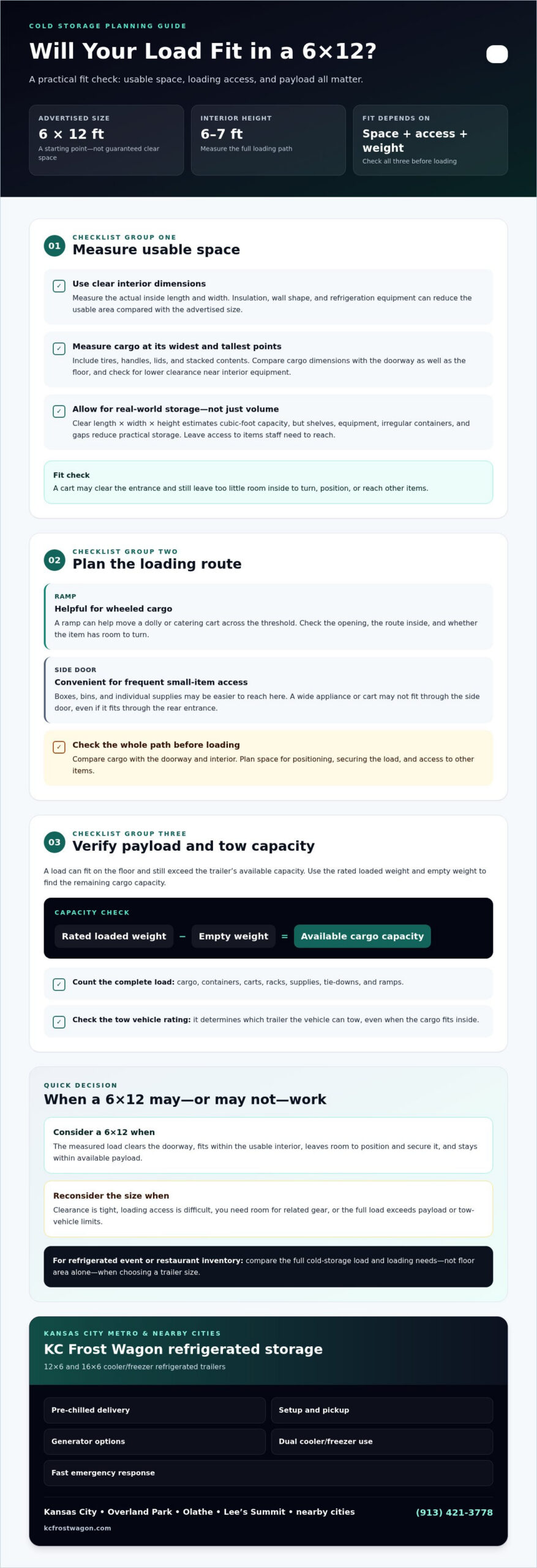
Weight can rule out a trailer that has enough floor area. Available cargo capacity is the trailer’s rated loaded weight minus its empty weight. The remaining capacity must cover the cargo and any equipment traveling with it.
Include the complete inventory in your weight estimate. For catering or an event, count containers, carts, racks, and supplies together. Compare the total with the trailer’s available payload and the tow vehicle’s rated towing capacity. The tow vehicle’s rating determines which trailer it can tow, even when the cargo fits inside.
- Choose by dimensions: Measure cargo and include gear or accessories.
- Choose by weight: Subtract empty weight from the loaded rating, then account for tie-downs and ramps.
- Choose by utility: Match the trailer width and length to the item and its loading needs.
For refrigerated event or restaurant inventory in the Kansas City area, discuss your cold-storage load when comparing trailer size and cargo requirements.
Loading access through the ramp and side door
Loading access affects whether cargo can enter smoothly, not just whether it fits on the floor. In a 6×12 enclosed trailer, the ramp and side door serve different loading needs.
A ramp can make it easier to move wheeled cargo, such as a refrigerator dolly or catering cart, across a threshold. The item still needs enough clearance through the opening and room to turn inside. Measure both the item and its route into the trailer before loading.
A side door can make frequent access easier for smaller boxes, bins, or individual supplies. It may not accommodate a wide appliance or cart, even if that item fits through the rear entrance. For a six-foot-wide trailer, compare the cargo’s width with the narrowest doorway and account for handles, packaging, and protruding parts.
Loading order matters. Place items needed first near the accessible door, and position larger cargo so it does not block the route. For example, a restaurant load with a refrigerator and supply bins is easier to unload if staff can reach the bins without shifting the appliance. Leave room to secure each item.
Trailer length also needs a loading buffer. For the longest item, allow a few feet beyond its measured length for tie-down room and maneuvering. A twelve-foot floor that barely matches the cargo length leaves little space to position straps or adjust the load. Measure the item as it will travel, including attached parts or protective packaging.
Weight remains important during loading. The loaded trailer must stay within its rating, and ramps, straps, and carried equipment count toward the total. Keep heavy cargo low and secure it so it cannot shift during transport. A ramp’s own weight also uses some available payload, so include loading equipment in the planned load.
For multiple items, sketch a simple layout before loading. Mark the longest item, the heaviest item, and the items needed first. Then check whether the plan allows:
- Clear access from the ramp or side door to each item.
- Space to position tie-downs without blocking doors.
- Room for the full load while staying within the trailer’s rating.
Axle configuration is another factor, but tandem axles alone don’t determine payload. Compare the specific trailer’s rating and empty weight with the complete cargo load. Careful measurements and a loading plan help prevent a doorway bottleneck or a layout that leaves no practical room for securing enclosed cargo.
That buffer is part of the working space needed at the end of the load, rather than room to count on for additional cargo. For the longest item being hauled, trailer length should include a few feet of buffer for tie-down room and loading. Keeping that clearance in the plan leaves room to position and secure the load.
Appliances and payload limits
A washer, dryer, and refrigerator can physically fit inside a 6×12 enclosed trailer, but together they use most of a single-axle model’s payload. The weight limit depends on the trailer’s loaded rating and empty weight, not its floor space alone.
Some single-axle models have a 3,500-pound gross vehicle weight rating, or GVWR. GVWR is the maximum total loaded weight, including the trailer itself. It isn’t the amount of cargo the trailer can carry.
Calculate available payload by subtracting the empty trailer weight from its loaded rating. That remaining capacity must cover the cargo and loading equipment, not just the appliances.
Refrigeration equipment affects a cooler trailer’s empty weight. Insulation, interior fittings, and the refrigeration unit are part of the trailer, so available payload depends on its specific weight and rating. Use the trailer’s specifications for the calculation rather than a general enclosed-trailer estimate.
A tandem-axle 6×12 enclosed trailer often carries more than 5,000 pounds of payload, depending on its build. Tandem axles don’t automatically establish the weight limit; the specific trailer’s rating and empty weight determine its available capacity. The tow vehicle’s rated towing capacity also limits the loaded trailer it can tow.
For an appliance load, count every item traveling inside. A refrigerator, washer, and dryer all contribute, as do furniture, straps, ramps, and other equipment. Record each item’s weight, then compare the combined load with the trailer’s available payload. If an appliance label lists its weight, use that figure rather than estimating from its size.
- Check the trailer: Find its GVWR and empty weight.
- Calculate the allowance: Subtract empty weight from GVWR.
- Count the full load: Include appliances, furniture, ramps, and tie-down gear.
- Match the vehicle: Keep the loaded trailer within the tow vehicle’s rated capacity.
Floor space can make an appliance load appear manageable while payload is already near its limit. For example, three large appliances may fit inside but leave little capacity for other cargo on a single-axle model. Choose by both interior fit and remaining weight allowance, especially when the trailer includes refrigeration equipment.
What fits in a 6×12 trailer
There’s no universal food or beverage count for a 6×12 cooler trailer. The amount depends on how products are packaged and arranged, and whether the load needs room for organized access during service. Think in terms of your operation’s storage plan, not a generic serving estimate.
A wedding caterer may need to keep prepared dishes, ingredients, and beverages organized. A restaurant dealing with a refrigeration interruption may prioritize containers staff can retrieve quickly. At a festival, beverage cases may be grouped for replenishment while food is arranged by service station. The intended use affects what storage can practically hold.
Packaging matters. Uniform cases create a more predictable load than a mix of trays, tubs, and irregular containers. Sturdy, stackable packaging can make better use of vertical space, while fragile or oddly shaped items may need separate placement. Arrange items to suit their contents rather than forcing everything into the same pattern.
Consider how the contents will be used during the event. If staff need frequent access to drinks, place those cases where they can reach them without disturbing prepared food. For a plated dinner, grouping containers by course or serving station may reduce unnecessary handling. Plan storage around the work happening outside the trailer.
How much fits in a 6×12 cooler trailer also depends on whether you’re storing one product category or combining several. A beverage-only load can be arranged differently from a mixed catering load with pans and ingredient containers. With mixed contents, leave a clear distinction between groups so staff can find what they need without shifting other supplies.
- For a wedding: Organize food by service stage, such as preparation, reception, and late service.
- For a restaurant: Keep frequently needed backup products easy for staff to identify and retrieve.
- For a festival: Separate restock items by station to support repeated replenishment.
- For mixed loads: Use consistent labels and group similar packages together.
A useful estimate comes from describing the load as it will actually be stored: cases, covered pans, tubs, or racks. This makes it easier to discuss whether the arrangement suits your operation, without relying on an assumed number of servings. The clearer the storage plan, the easier it is to determine how much fits in a 6×12 cooler trailer for your event.
For food or beverage storage in the Kansas City metro and nearby cities, share your event’s cold-storage needs or call (913) 421-3778.
A 6×12 enclosed trailer can usually cover a one- or two-bedroom home move without requiring a second trip. That moving capacity offers a comparison, but it does not translate directly into a food or beverage quantity: household goods and cooler contents have different shapes, packaging, and access needs. For an event load, keep estimating from the actual cases, pans, tubs, and racks, and account for the space needed to reach items during service. A stated trailer capacity cannot replace a product-by-product storage plan. Describe the contents and their planned arrangement when deciding whether the trailer suits the job.
KC Frost Wagon: 12×6 cooler/freezer refrigerated trailer
KC Frost Wagon offers 12×6 and 16×6 cooler/freezer refrigerated trailers for commercial and event cold storage. Cooler or freezer use lets Kansas City metro restaurants, caterers, and event planners match temporary storage to the products they need to protect.
For a refrigeration breakdown or power outage, KC Frost Wagon provides 24/7 emergency refrigeration response. The trailers are available for rental across the Kansas City metro, including nearby cities such as Overland Park, Olathe, and Lee’s Summit.
Contact KC Frost Wagon to discuss your storage needs and request a quote.
Turn your load plan into a cold-storage plan
Knowing how much fits in a 6×12 cooler trailer is only part of planning. The next step is to connect your inventory with the work it needs to support: receiving deliveries, staging food, and serving guests. A clear plan helps you decide what should stay accessible and what can remain in storage during service.
For Kansas City metro restaurants, caterers, and event planners, timing and site setup matter alongside cargo fit. Think through when supplies arrive, where the trailer can be positioned, and how your team will move items between storage and service areas. Those details make it easier to discuss the right cold-storage arrangement for your operation.
KC Frost Wagon offers refrigerated trailer rental for commercial and event needs in the Kansas City metro and nearby cities. Share the purpose, location, and storage requirements for your project to request a quote and discuss availability.
Contact KC Frost Wagon about your trailer, and move ahead with a cold-storage plan built around your next service or event.
Frequently Asked Questions
Will a side-by-side fit in a 6×12?
It depends on the side-by-side’s actual width and the trailer’s clear doorway and interior width. Measure across the widest point, including tires, then compare that figure with the narrowest opening. Many popular side-by-sides exceed 60 inches at the tires and may need a 7-foot-wide trailer box. A Kansas City event crew should also account for loading clearance and space for gear, not just whether the vehicle can pass through.
What are the interior dimensions of a 6×12 cooler trailer?
A 6×12 trailer’s advertised size refers approximately to its exterior body width and floor length, not guaranteed clear interior dimensions. The nominal measurements are six feet wide and twelve feet long; typical enclosed-trailer interior height ranges from 6 to 7 feet. A cooler trailer’s insulation and refrigeration equipment can reduce usable space. For a restaurant delivery in Overland Park or Olathe, plan around the clear loading area and the cargo’s actual dimensions.
How many pallets fit in a 6×12 refrigerated trailer?
There isn’t one fixed pallet count for every 6×12 refrigerated trailer. The number that fits depends on pallet dimensions, usable floor width, door clearance, refrigeration equipment, and the load’s total weight. Sketch each pallet’s footprint against the trailer’s clear floor space, then account for access and airflow around stored products. For catering or event inventory around Lee’s Summit, Independence, or nearby cities, include the loaded pallet weight in your capacity plan.

