
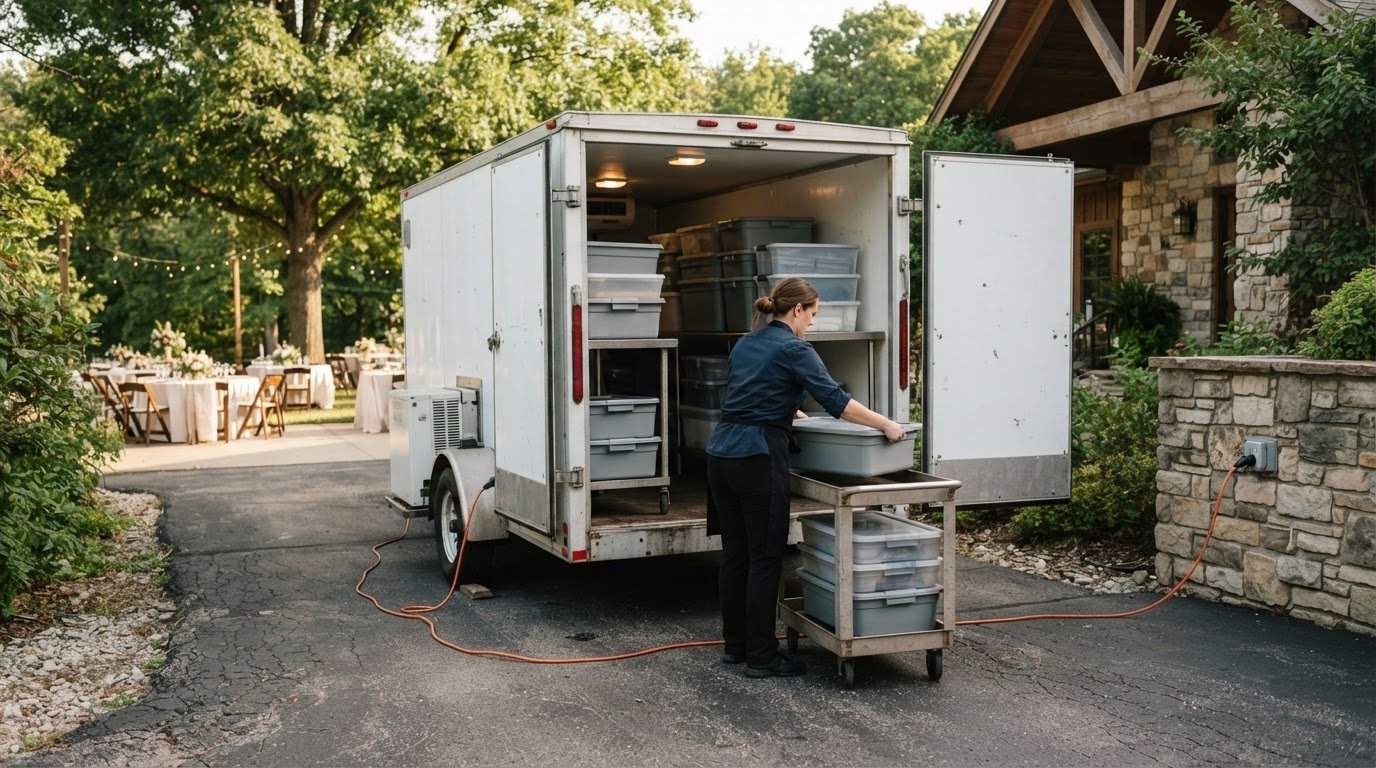
The largest trailer isn’t automatically the best fit. For refrigerated trailer rental in Liberty, MO, compare capacity, power, loading access, delivery, and rental terms. Kansas City-area options include 12×6-foot and 16×6-foot trailers, and they plug into a standard 120V outlet.
That checklist matters whether you’re protecting restaurant inventory during a refrigeration breakdown or keeping food organized for a wedding, catered event, or festival. Match the trailer size and power setup to your load and delivery site.
This guide explains how to choose a refrigerated trailer rental in Liberty, MO, estimate the storage space you need, and plan power and delivery. KC Frost Wagon rents portable cooler and freezer trailers in the Kansas City metro, including Liberty, with delivery, setup, and pickup.
Key Takeaways
- Compare rental options by refrigeration needs, rental terms, delivery logistics, and how well the equipment suits your site.
- Use the 12×6-foot and 16×6-foot trailer sizes as a starting point, then estimate space based on what you need to store and access.
- Plan for a standard 120V outlet and consider how the trailer’s placement will affect power access.
- Review loading access, ramp needs, and interior visibility so moving and retrieving supplies works smoothly.
- Understand which details shape a rental quote and delivery plan before choosing a trailer for an event or backup storage.
What should I look for in a refrigerated trailer rental company?
Start with the products you need to store, then match the trailer’s temperature mode and controls to those needs. For a restaurant, wedding, or festival in Liberty, also consider towing, delivery coverage, and how you’ll inspect the unit.
Refrigerator, Freezer, and Dual-Temperature Options
A refrigerator setting suits items that need to stay chilled, while a freezer setting is intended for products that must remain frozen. Dual-temperature use can help when an event needs both chilled ingredients and frozen stock. Before choosing, list the products, their handling requirements, and how long they’ll be stored. For example, a caterer holding drinks and frozen desserts has different needs from a restaurant storing chilled ingredients only.
Tell KC Frost Wagon whether your load needs chilled or frozen storage and what you’ll be storing. KC Frost Wagon specializes in renting cooler and freezer trailers for commercial and event use, so choose the configuration that fits your inventory and access plan.
Temperature Range and Controls
Cold-chain needs depend on the products being held, so use their handling instructions to define the target temperature. Then compare that target with the trailer’s operating range and control system. A freezer requirement differs from a chilled-food requirement, and a setting that suits one load may not suit another. Keep the product instructions available when planning storage.
Look for adjustable controls and a clear way to read the temperature during use. Check where the control panel is and how you’ll monitor it after loading. Ask how settings are adjusted and what temperature-control features are included, such as a visible display or alerts. Treat those as comparison points, not assumed features.
Rental Requirements and Service Area
For a Missouri rental, review the rental agreement for insurance, driver, and towing terms. Confirm who handles towing and whether your vehicle is suitable for the trailer’s weight and hitch. Requirements can depend on the equipment and agreement, so don’t assume a standard license or insurance arrangement applies to every rental.
Where can you rent in Liberty, MO? Choose a refrigerated trailer rental company that serves Liberty and the Kansas City metro, and compare its delivery and pickup arrangements. What companies serve Liberty and Kansas City? Look for providers with coverage in both areas, then compare trailer types, temperature options, and rental terms rather than relying on a city name alone.
Booking and Trailer Inspection
How far ahead should you book near Liberty? Book once you know your event dates, inventory, and site setup; seasonal demand and equipment needs affect timing. For an urgent breakdown, explain the storage need and location promptly so the rental plan can address the immediate situation.
At delivery, inspect the exterior, doors, floor, seals, controls, and visible temperature reading. Confirm the agreed settings before loading, and note any existing damage with the rental representative. At return, remove stored products, check the interior and doors, and document the trailer’s condition. These steps create a clear record from handoff through pickup.
Trailer size and storage capacity
Match trailer dimensions to the inventory you need to store and the space available at your Liberty site. Kansas City-area refrigerated trailers include 12×6-foot and 16×6-foot sizes, giving you two footprints to compare.
Available Trailer Sizes
A 12×6-foot trailer has a smaller footprint than a 16×6-foot model, while both are six feet wide. Compare those dimensions with the available parking area, access route, and location where staff will retrieve products. For a wedding venue or restaurant, sketch the placement beside nearby doors, service areas, and vehicle paths before choosing.
The trailer’s footprint alone doesn’t determine how much usable storage your load requires. Containers and the space needed to reach products affect how inventory fits. List the largest items and the containers you’ll use, then plan an arrangement that keeps products accessible.
Choosing Storage Capacity
Start with an inventory count, not a guess based on event size. Separate products by container, dimensions, and access frequency. A caterer storing several large food containers needs a different layout from a festival organizer holding smaller packaged items. Leave a workable path to reach what staff need during service.
Full-size semi reefer trailers are another scale to consider. Their larger footprint can require more room for placement and maneuvering, so compare the site layout before selecting one. A compact trailer may better suit a restaurant parking area, while a large commercial operation may need to assess whether a semi can access its loading area.
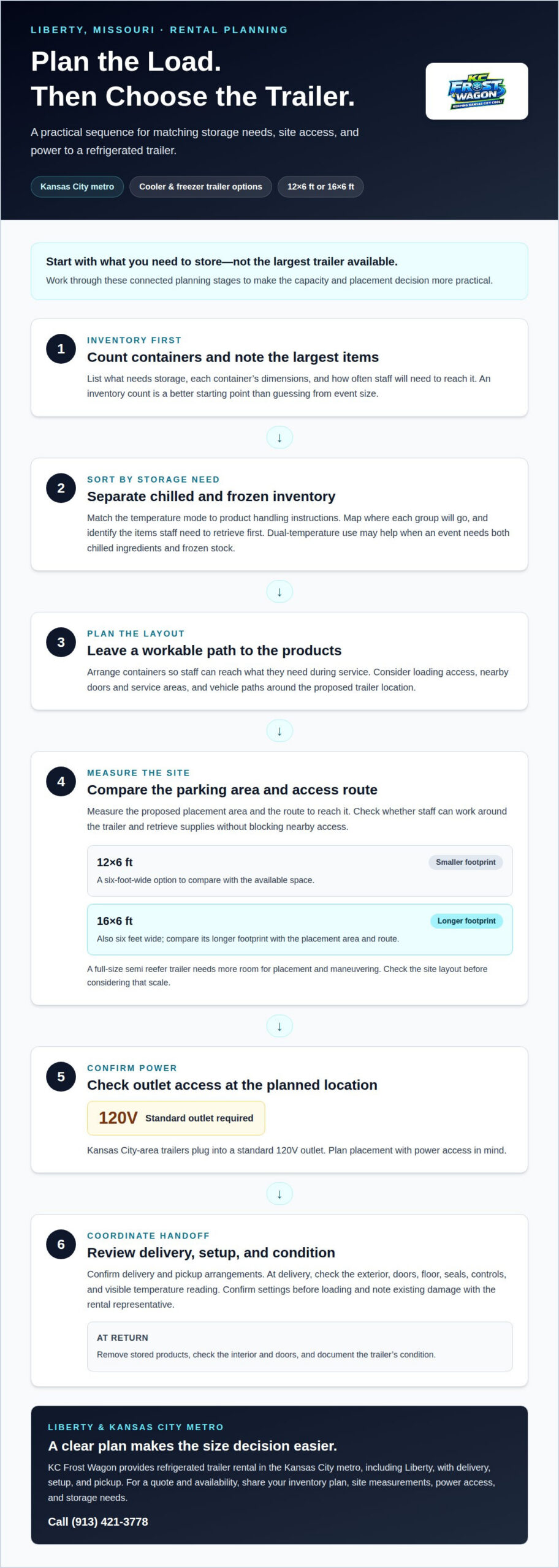
Use this simple planning sequence before requesting a quote:
- Count the containers and note the largest dimensions.
- Separate chilled and frozen inventory, then map the intended arrangement.
- Measure the proposed parking area and the route to reach it.
- Identify which products staff must retrieve first during service.
For example, a Liberty caterer can measure a venue’s designated service area, then compare that space with the 12×6-foot and 16×6-foot footprints. A restaurant preparing for a delivery disruption can inventory its essential stock and decide which items need the fastest access. These steps make the capacity decision more practical than choosing by trailer size alone.
Share your inventory plan and placement details when discussing a rental. For a Liberty-area quote, discuss your trailer space and storage needs, or call (913) 421-3778.
Trailer sizes and electrical requirements
Near Liberty, refrigerated trailers are available in 12×6-foot and 16×6-foot sizes. Kansas City-area units plug into a standard 120V outlet, so assess site power before delivery. Temperature range depends on the unit’s cooler or freezer mode and its controls.
Power Options
Choose a power plan around the rental location. An electric hookup suits a site with an accessible outlet; a generator can support locations without convenient building power. Generator-ready trailer options can help event planners prepare for outdoor setups, while restaurants may prefer a position near an existing outlet.
Diesel-powered refrigeration is another configuration to compare in the broader rental market. It differs from an electrically powered unit because its refrigeration system relies on fuel rather than the site’s outlet. Don’t assume every trailer supports both methods. Match the actual power setup to the site and the planned rental use.
For a festival in Liberty, map the trailer location, outlet access, and any generator placement before delivery. For a restaurant backup, identify which outlet can serve the trailer without disrupting essential kitchen equipment. These steps help the operator place the unit where power can reach it.
Electrical Requirements
A standard 120V outlet is the stated electrical requirement for Kansas City-area trailers. Before delivery, locate the outlet and confirm it can reach the planned parking spot. Account for the route from the power source to the trailer, keeping cords clear of walkways, service paths, and vehicle movement.
Ask which power cord is supplied and how the connection should be handled. Don’t assume a household extension cord is suitable or that a distant outlet will work. The outlet’s location, cord reach, and the trailer’s placement all affect a workable setup. Share a site layout when arranging delivery.
Use this quick site check:
- Mark the trailer’s parking position and identify the nearest outlet.
- Measure the route between the outlet and the intended connection point.
- Keep the power path clear of customers, staff, and delivery vehicles.
- Plan a generator location if the site setup needs generator power.
Temperature settings also matter. Use the product’s storage instructions to determine whether chilled or frozen operation is needed, then match that mode to the trailer’s controls. Ask about the equipment’s available operating range and how staff can read its temperature during use. This avoids guessing based on the label “refrigerated.”
For a site-specific power plan in Liberty or nearby Kansas City communities, share your trailer location and outlet setup, or call (913) 421-3778.
Loading access, ramps, and interior lighting
Plan how food, beverages, and catering supplies will move from your vehicle into the trailer. At a Liberty event site, the door position, ground surface, and lighting can affect each loading trip.
Start with the route. Check the path from the delivery point to the trailer, noting turns, slopes, uneven pavement, and nearby service doors. A caterer moving stacked containers needs a clear route, while a restaurant receiving boxed stock may need space for carts. Mark the planned parking spot so vehicles and staff can still pass.
Inspect the door opening and the step between the ground and trailer floor. Consider the largest container or cart you’ll move, then check whether it can pass through without tilting or catching. If a ramp is provided, look at its length, surface, stability, and placement. The ramp should meet the ground cleanly and leave enough space for safe movement.
For a wedding or festival, plan the loading flow before deliveries begin. Keep the entrance clear, assign a staff member to manage incoming supplies, and avoid crossing the route with guest traffic. During an emergency transfer from a failed cooler, prioritize essential products and stage them near the entrance. A clear route helps keep loading organized.
Interior lighting matters during early setup, evening service, and quick inventory checks. Inspect the light with the trailer door open and closed, and look for dark corners behind stored containers. LED lighting can make labels and product locations easier to see, but don’t assume a particular light type or fixture is included. Confirm the actual interior setup during inspection.
An antimicrobial interior surface may be a useful feature to evaluate, but it doesn’t replace cleaning between uses. Look for a smooth, intact interior that staff can inspect and clean as part of normal handling. Check corners, seams, door edges, and areas beneath shelves for residue or damage. Follow the unit’s cleaning instructions rather than relying on a surface label alone.
Use this loading and return check:
- Walk the access route with the largest cart or container.
- Inspect the doorway, ramp, floor, and visible interior surfaces.
- Test interior lighting and check visibility at the back of the trailer.
- Keep the entrance and service path clear during loading.
- At pickup, remove supplies and leave the floor and doorway accessible for inspection.
For Liberty restaurants and event teams, these checks help match the trailer setup to the real worksite. Record any existing damage at handoff, then compare the interior condition again before pickup. A simple written note and clear photos can help document the unit’s condition throughout the rental.
Refrigerated trailer rental prices and delivery
For a Liberty rental, plan the rental period and delivery details together. Site access, placement, and power arrangements all affect how well the trailer fits your operation.
Rental Minimums and Delivery Fees
Kansas City-area refrigerated trailer rentals have a three-day minimum. Build that minimum into your calendar, even if a wedding, festival, or restaurant backup need lasts less time. The rental price depends on the case and is provided after a quote request; rental duration, trailer size, delivery distance, and site access shape the quote.
Ask for the total rental terms in writing, including the rental period, delivery arrangements, pickup, and any fees tied to the location. For example, a Liberty event planner should share the venue address and dates together. That gives the quote a clear basis and helps avoid comparing one rental period against another.
Delivery distance matters. Free delivery is available within 25 miles of the service area. For locations beyond that area, include the destination when requesting a quote so the delivery plan reflects the actual route. Don’t assume the rental term or delivery details are identical for every location.
Delivery, Placement, and Security
Before delivery, choose a level area with enough room for the trailer and access to its doors. Identify the route from the street or loading entrance, then clear parked vehicles, equipment, and event supplies. A wedding venue may need the trailer near its service entrance, while a restaurant may prioritize a practical route from receiving to storage.
Discuss placement and setup as part of arranging delivery. A level site helps the trailer sit properly, and access to the planned power source should fit the site layout. Identify any gate, slope, narrow turn, or restricted delivery window in advance. These details help determine where the trailer can be placed and how the delivery vehicle can reach it.
Plan security after placement. Choose a visible location within the working area, and limit access to staff responsible for stored inventory. Keep the route to the trailer clear during service. For an outdoor festival in Liberty, include the trailer’s position in the site plan, away from guest traffic and routine loading paths.
At pickup, leave the access area open and the trailer ready to be collected. Confirm the pickup plan when arranging delivery, then coordinate staff coverage so event operations don’t block removal. Clear handoff details help avoid disrupting kitchen work or event breakdown.
Share your Liberty delivery address, rental dates, and placement needs to request a rental quote and delivery plan.
KC Frost Wagon: 12×6 cooler/freezer refrigerated trailer
KC Frost Wagon offers 12×6 and 16×6 cooler/freezer refrigerated trailers for commercial and event cold storage. For a Liberty restaurant, caterer, wedding, or festival, choose the size and cooler or freezer use that fits your inventory and site plan.
Pre-chilled delivery, setup, and pickup help organize the storage handoff. Generator options support locations where site power needs another plan. If equipment fails or power goes out, KC Frost Wagon provides 24/7 emergency refrigeration response.
KC Frost Wagon serves the Kansas City metro and nearby cities. Contact the team to discuss a quote and availability for your Liberty delivery: call (913) 421-3778 or visit kcfrostwagon.com.
Make your next cold-storage plan
Turn your storage plan into a clear next step. For refrigerated trailer rental in Liberty, MO, share your dates, inventory needs, and delivery location with KC Frost Wagon. Those details help match the rental to the way your restaurant, catering team, or event will operate.
KC Frost Wagon serves Liberty and communities throughout the Kansas City metro, including Kansas City, Overland Park, Olathe, Lenexa, Shawnee, Leawood, Lee’s Summit, Independence, Blue Springs, and Prairie Village. For planned events or urgent refrigeration breakdowns, share your storage needs, site location, and power setup to discuss the rental.
Contact KC Frost Wagon to discuss your rental and take the next step toward a practical cold-storage plan.
Frequently Asked Questions
How much does refrigerated trailer rental cost in Liberty, MO, including delivery and mileage fees?
For refrigerated trailer rental in Liberty, MO, the price depends on your situation and is provided after a quote request. Share your dates, trailer size, delivery address, and placement details so the quote reflects the rental period and delivery plan. Include access constraints, such as a narrow entrance or distant parking area. Those details help shape the quote without assuming a separate mileage fee.
Are short-term, daily, weekly, and monthly refrigerated trailer rentals available near Liberty?
Day-use trailer rentals are offered. For a short event or a longer planned rental, provide the complete start and end dates when requesting a quote. For example, a restaurant planning backup storage during scheduled work can share its expected rental period, while a festival organizer can provide event dates and setup needs. The rental plan can then be based on the intended use period.
Can refrigerated trailers be delivered to a home, business, or event location in Liberty, MO?
Yes, refrigerated trailer rental in Liberty, MO includes delivery to event sites within the Kansas City metro area. A business or home location can be considered based on its access and placement layout. Service coverage includes Kansas City, Overland Park, Olathe, Lenexa, Shawnee, Leawood, Lee’s Summit, Independence, Blue Springs, Liberty, and Prairie Village. Share the destination and intended parking area when arranging delivery.
What power supply or hookups does a refrigerated trailer need while parked?
A trailer can connect to a dedicated 120V outlet or be rented with a generator. Each trailer is available with or without a generator, so plan the setup around the location’s power access. For example, a restaurant may have an outlet near its receiving area, while an outdoor event may need the generator option. Include the parking location in your setup plan.
What licenses, insurance, or towing requirements apply to renting a refrigerated trailer in Missouri?
Review the rental agreement for insurance, driver, and towing terms; the stated agreement requires at least $1,000,000 in insurance coverage per occurrence and operators over 21. Confirm who handles towing and that your vehicle is suitable for the trailer’s weight and hitch. For events involving alcohol, the agreement requires a valid New York State Liquor Authority temporary license or special event permit.

