
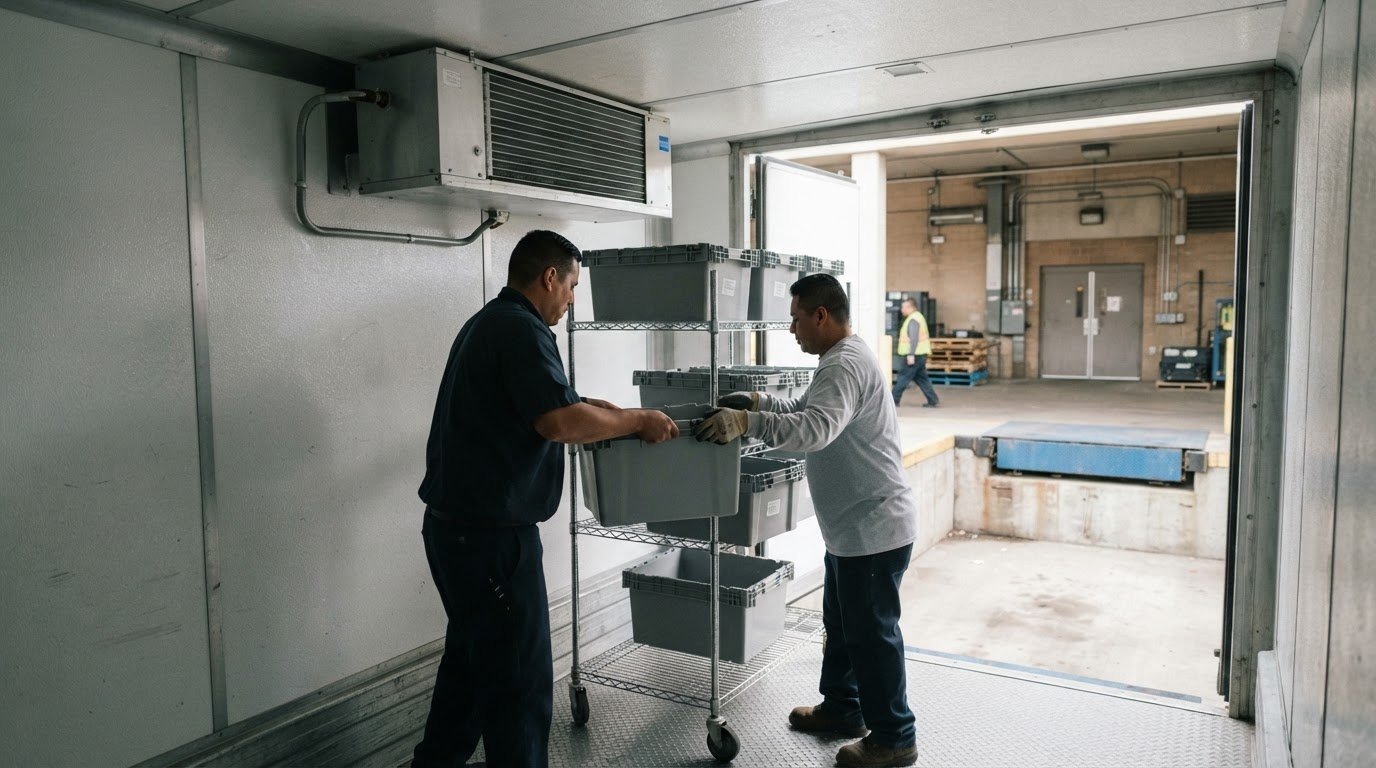
A generator alone is not a complete refrigeration plan. Emergency refrigeration for a hospital means matching temporary cooling to the inventory at risk, the available power, and a workable equipment location. The Centers for Disease Control and Prevention recommends arranging an agreement with at least one alternative vaccine storage facility, even when a generator is available.
A power outage or equipment failure can put temperature-sensitive supplies at risk while staff manage other urgent facility needs. A clear plan helps teams prioritize inventory, identify usable backup power, and fit temporary cold storage into hospital operations.
This guide covers emergency power planning, cooling equipment and electrical needs, delivery routes, and mobile refrigeration deployment. It also explains which details help determine whether a refrigerated trailer, mobile cooler, or mobile freezer suits a temporary storage need in Kansas City and nearby communities.
Key Takeaways
- Plan for power interruptions and identify an alternative storage location for temperature-sensitive supplies, even when backup generation is available.
- Match temporary cooling equipment to the items being stored, their temperature needs, the available power, and the expected outage or repair timeline.
- Map loading docks, service elevators, and back corridors ahead of delivery so equipment can reach its intended location with fewer delays.
- Choose a deployment location that supports access, safe operations, and staff workflows while keeping critical inventory close at hand.
- Review storage capacity and electrical requirements together to determine whether a temporary refrigeration setup fits the facility’s needs.
Emergency power connections and outage resilience
Emergency refrigeration for a hospital requires both a power plan and suitable cooling equipment. Identify critical temperature-sensitive inventory, the systems that store it, and the backup connection available during an outage. This helps facilities teams choose equipment based on actual loads, not just a generator’s rating.
Household or commercial refrigerators may not have the capacity or temperature performance required for every medication or supply, and a power interruption can disrupt temperature control. If staff cannot establish that sensitive inventory stayed within its required range, they may need to follow facility procedures before using it.
Connection type matters. Portable medical refrigerators may operate from 12V or 24V vehicle outlets, or from 110V or 240V AC facility power. A vehicle connection can support transport, while AC power suits a prepared facility connection. Plan the handoff between power sources so moving supplies doesn’t leave equipment disconnected longer than necessary.
Size backup capacity for the equipment’s operating load and any other devices sharing the power supply. Approximate examples include:
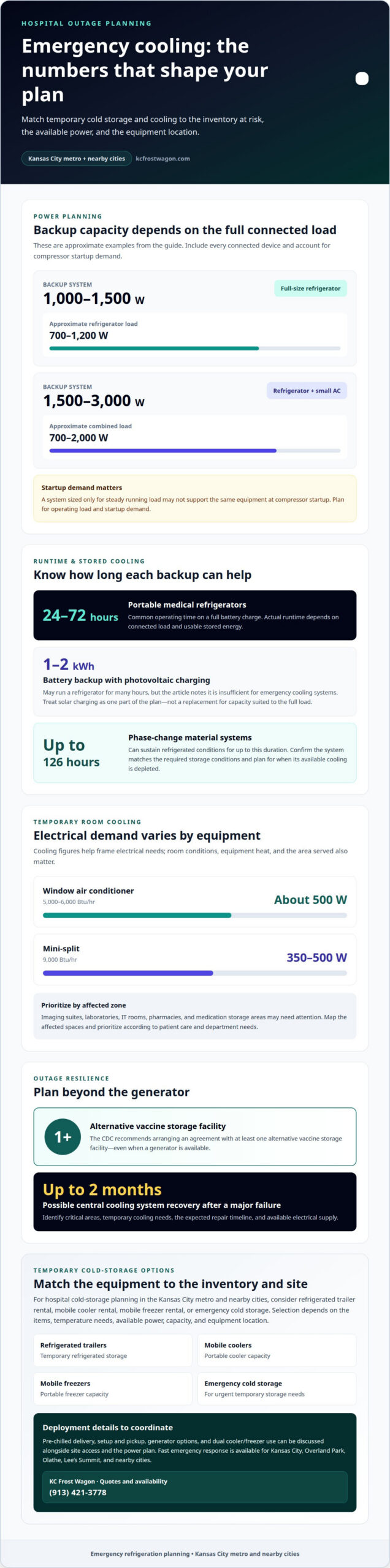
- A 1,000-1,500 W backup system can serve a full-size refrigerator with an approximate load of 700-1,200 W.
- A 1,500-3,000 W system can serve a full-size refrigerator and a small air conditioner, with an approximate combined load of 700-2,000 W.
These examples show why the load plan should include all connected equipment. Startup demand can differ from a refrigerator’s running load, so account for compressor startup when selecting backup capacity. A system sized only for steady operation may not support the same equipment at startup.
Battery runtime depends on the connected load and usable stored energy. Battery-powered portable medical refrigerators commonly operate for 24-72 hours on a full charge. A 1-2 kWh battery backup with photovoltaic charging can run a refrigerator for many hours, but it’s insufficient for emergency cooling systems. Treat solar charging as one part of a power plan, not a substitute for capacity suited to the full cooling load.
Power use also affects operating costs. Energy consumption varies with equipment load and compressor runtime, while electricity rates affect the bill. For backup planning, compare expected runtime and connected loads, then account for the facility’s power costs. Battery-system purchase costs also depend on system capacity and configuration.
Plan beyond the generator. The Centers for Disease Control and Prevention (CDC) recommends arranging an agreement with at least one alternative vaccine storage facility, even when a generator is available. Include this fallback in the outage response plan alongside power connections and the steps staff follow to protect sensitive inventory.
Emergency cooling equipment and electrical loads
A hospital cooling failure can affect more than refrigerated inventory. Imaging suites, laboratories, and IT rooms also rely on controlled environmental conditions. Facilities teams can map affected zones, identify heat-sensitive equipment, and prioritize cooling according to patient care and department needs. This assessment helps distinguish a local equipment problem from a wider building cooling disruption.
A central cooling failure may require extended temporary planning. After a major failure, a hospital’s central cooling system may take up to two months to return to operation. Identify critical areas and temporary cooling needs before choosing equipment. The response plan should account for affected zones, the expected repair timeline, and available electrical supply.
Temporary cooling equipment must match both the zone and its electrical supply. A 5,000-6,000 Btu/hr window air conditioner draws about 500 watts. A 9,000 Btu/hr mini-split typically operates at 350-500 watts. These figures help frame electrical demand, but the required cooling also depends on room conditions, equipment heat, and the area being served.
Imaging suites and IT rooms can generate substantial internal heat, even in winter. Pharmacies and medication storage areas may also need cooling if building systems fail. A zone-first response directs temporary equipment to critical spaces. For example, a hospital might prioritize a laboratory holding sensitive materials over an administrative area with less immediate cooling need.
Phase-change material (PCM) systems can sustain refrigerated conditions for up to 126 hours. Their stored cooling capacity may help bridge an interruption, but the system still needs to match the required storage conditions and inventory. Teams should consider what the PCM system can support, how long that support is needed, and what happens when its available cooling is depleted.
Emergency cooling and heating are separate facility needs. A cooling failure may threaten pharmaceutical storage or raise temperatures in an IT room. A heating failure requires a different response based on affected zones and facility conditions. Identify the failed system, whether the disruption is localized, and what temporary equipment can address the affected area without disrupting patient care.
For temporary cold-storage planning during a Kansas City facility disruption, discuss emergency refrigeration needs alongside the affected inventory, site access, and power plan. Those details help frame a practical cold-storage response while distinguishing it from whole-building HVAC service.
Emergency equipment delivery and installation
Emergency delivery planning connects the receiving area with the final storage location. For hospital facilities in Kansas City, mapping this route helps staff prepare for equipment arrival while maintaining access and daily operations.
Equipment Delivery and Access Logistics
Delivery and access planning means working out how temporary refrigeration will move from the drop-off point to its operating location. A blocked loading dock or unsuitable corridor can delay access to storage during an equipment failure. Map loading docks, service elevators, and back corridors, then note turns, doorways, restricted areas, and the destination before dispatch.
Include the inventory and destination in the route plan. A pharmacy storing temperature-sensitive medications may need a different route from a laboratory holding specimens or research samples. Naming the destination department helps receiving staff guide the equipment without routing it through unrelated work areas.
Coordinate arrival with the teams responsible for the route and final placement. A loading dock may serve several departments, and a service elevator may be shared with routine facility work. Identify access limits and the person who will guide the equipment from the dock to its intended storage area.
Placement planning involves more than moving equipment indoors. The final position should allow loading, unloading, and staff movement around nearby workstations. Placing temporary cold storage beside a pharmacy, for example, may shorten the transfer route, but the location must still support normal department activities.
Thermal Reserve and Standby Equipment
Thermal reserve is available cooling capacity that helps protect stored items during a disruption; standby equipment provides an alternative storage option. Both matter if repairs take longer than expected. Plan around the affected inventory so a short interruption and an extended refrigeration failure do not trigger the same response.
Temporary cold storage may hold vaccines, specialty medications, pharmaceuticals, laboratory specimens, biological materials, research samples, and other temperature-sensitive medical supplies. Group contents by storage requirement and department. This makes it easier to assign inventory to suitable equipment and limit unnecessary transfers during a repair.
Standby planning should specify when staff move inventory, where it goes, and how the route will remain clear. If a pharmacy unit fails, for example, the plan can direct designated supplies to prepared temporary storage instead of leaving each department to improvise. Facilities teams can also identify who coordinates access and communicates when the original system can safely return to service.
For hospitals in Kansas City, a delivery plan covering routes, destination, inventory, and standby storage gives facilities teams a practical framework for emergency deployment.
Mobile refrigeration setup and deployment
Mobile refrigeration provides a temporary cold-storage point near the work area. Successful deployment depends on fitting the unit, inventory, access route, power connection, and monitoring plan to the site.
Start by identifying what the unit will hold. Vaccines, medications, specimens, and research materials can have different temperature requirements. A portable refrigerator’s capacity can range from 0.35 cu ft to around 30 cu ft, so usable space matters as much as the unit’s footprint. Estimate the volume of the specific inventory and leave room for staff to load and retrieve items without crowding.
Next, match the equipment to the storage purpose. Portable medical refrigerators for vaccines and medications are described as maintaining 36°F to 46°F (2°C to 8°C). Frozen storage needs a freezer rather than a cooler. Do not treat a general commercial cold-storage unit as a substitute for medical equipment unless its operating range suits the stored items.
Place the unit near the department that needs it, while accounting for staff movement and patient care. A pharmacy may need storage close to medication handling; a laboratory may need access that avoids disrupting specimen workflows. In either case, a clear route from the delivery point to the final position reduces unnecessary handling during an outage.
- Position the unit on an accessible route that supports routine loading and retrieval.
- Connect it to an appropriate power source; mobile refrigeration units can typically use standard 110V service.
- Organize vaccines or other supplies by storage requirement, then limit repeated transfers.
- Keep monitoring equipment visible and use the facility’s established response process for temperature alarms.
Monitoring helps teams spot temperature changes after setup. Healthcare refrigeration monitoring should typically record temperatures every 5-30 minutes. If a vaccine refrigerator’s monitoring device doesn’t display minimum and maximum temperatures, the Centers for Disease Control and Prevention recommends checking and recording the current temperature at least twice per workday.
Deployment also requires a clear handoff. The receiving team should know which department is responsible for the unit, what inventory it holds, and who responds to an alarm. For example, a pharmacy team can track its vaccine refrigerator while facilities staff manage the temporary power connection. Clear responsibilities help prevent gaps during shift changes or prolonged repairs.
When the original equipment returns to service, plan the transfer back rather than moving supplies immediately. Confirm that the destination unit is operating as intended, coordinate the move with the responsible department, and keep records according to facility procedures. An orderly transition helps maintain continuity through an outage and ensures portable storage is not left unmanaged.
What capacity and power requirements should hospitals check before arranging temporary refrigeration?
Start with the inventory, not the equipment size. Estimate the amount of space needed for each department’s supplies, then separate items by storage temperature and use. Centralized hospital refrigeration capacity is listed at 30-500+ cu ft, while decentralized systems are listed at 1-12 cu ft. Those ranges show why the affected storage area matters.
Decentralized hospital refrigeration systems are listed as supporting up to 4,000 vaccine doses. That figure is a capacity reference, not a measure of every facility’s needs. Vaccine packaging, existing stock, and access for staff all affect usable space. For a temporary setup, estimate what must move and whether staff need room to retrieve items without rearranging other supplies.
Match the equipment’s temperature capability to the inventory. Vaccines can have different storage requirements, so a refrigerator suited to one supply may not suit another. Frozen storage requires equipment designed for freezing conditions. Group inventory by required range before estimating capacity; mixing items with different needs can make an otherwise suitable unit inappropriate.
Then assess the electrical connection and the equipment’s operating load. An EnergyGuide example estimates refrigerator consumption at 630 kWh per year, or approximately 1.7 kWh per day. A larger, less efficient refrigerator example draws 6.5 A, equivalent to 780 watts at 120 V while operating. These examples illustrate why daily energy use and operating demand are separate planning considerations.
For a hospital, review every device that will share the intended circuit, not just the temporary refrigerator. Identify the available supply, the equipment’s stated electrical requirements, and whether a generator or backup circuit can support the planned load. The facility’s electrical team can assess the connection and other active equipment without relying on a refrigerator’s energy-use estimate alone.
- List the inventory by department and storage requirement.
- Estimate the needed internal capacity, including space for practical access.
- Compare equipment capacity with the amount and type of inventory being transferred.
- Review operating demand and energy use against the planned power source.
A pharmacy moving a limited vaccine supply, for example, may need a different capacity assessment from a facility consolidating several storage units. A laboratory with varied materials also needs a clear separation plan. Inventory quantity, packaging, storage range, access needs, and the expected length of the disruption all affect equipment selection.
For temporary refrigeration in Kansas City, request a quote for refrigerated trailer options with the storage volume, inventory type, and power plan. Those details help connect capacity and electrical needs to a practical temporary setup.
KC Frost Wagon
KC Frost Wagon helps Kansas City-area facilities add temporary cold storage during refrigeration disruptions. Its 12×6 and 16×6 cooler/freezer refrigerated trailers and mobile cooler rentals can support a planned backup setup or an urgent storage need. For hospital inventory, match the selected storage to the supplies’ temperature requirements and the facility’s power plan.
Delivery can be pre-chilled, with setup and pickup arranged to simplify deployment. Generator options and dual cooler/freezer use can also help shape a practical temporary plan. Service is available across the Kansas City metro and nearby cities, including Overland Park, Olathe, and Lee’s Summit.
For emergency refrigeration or to discuss a temporary storage setup, call KC Frost Wagon at (913) 421-3778.
Make readiness part of the operating plan
Prepare a short activation plan before a disruption forces rushed decisions. Name the person coordinating inventory movement, the team managing site access, and the department receiving updates. A shared plan helps clinical and facilities staff work from the same information instead of solving separate parts of the problem in isolation.
Emergency refrigeration planning for a hospital also includes the handoff back to normal operations. Specify who communicates status, how departments receive updates, and who coordinates the return of stored items. Add a backup route in case the planned delivery path becomes unavailable. These details make the plan practical during a facility disruption.
KC Frost Wagon can discuss temporary refrigeration needs for organizations in the Kansas City metro and nearby cities. Share the affected location, storage needs, and operating constraints to start a focused conversation. Contact KC Frost Wagon about refrigeration support, and take the next step toward a more prepared response.
Frequently Asked Questions
What are hospital refrigeration needs?
Hospital refrigeration needs vary by department and the supplies it stores. A pharmacy may need controlled storage for medications, while a laboratory may handle specimens with different temperature requirements. Separate inventory by purpose, required temperature range, and department. This makes it easier to select suitable equipment, estimate usable capacity, and plan access without mixing unrelated supplies.
What types of emergency refrigeration do hospitals need for medications, vaccines, and lab specimens?
Hospitals may need refrigerators for medications and vaccines, freezers for frozen materials, and specialized units for laboratory samples. Choose equipment according to each item’s required temperature range and the department’s handling practices. A pharmacy’s vaccine stock and a research lab’s frozen samples, for example, may require different equipment. Keep these categories separate and assign each to a unit suited to its requirements.
How quickly can emergency medical refrigeration units be delivered and installed?
Delivery and setup depend on the route, site access, equipment placement, and power arrangements. A clear receiving plan can prevent avoidable delays: identify the loading area, the intended storage location, and the staff member who will guide the delivery. For facilities in Kansas City, sharing access restrictions and the destination department helps coordinate the handoff. KC Frost Wagon delivers and sets up refrigerated trailers within the Kansas City metro area.
What are the costs to rent or buy emergency medical refrigerators and freezers?
Rental and purchase costs depend on equipment type, capacity, power needs, and the length of time storage is required. Buying and renting serve different needs: purchasing may suit ongoing use, while rental can address a temporary disruption. KC Frost Wagon rents refrigerated trailers for temporary use. To discuss a rental, describe the storage purpose, approximate inventory volume, site location, and expected use period.
What backup power options keep hospital refrigeration running during outages?
Hospitals can plan around facility power, a generator, or vehicle power for portable units during transport. The best arrangement depends on the equipment’s electrical requirements and the supply available at its location. Keep power planning tied to the specific unit and its destination, rather than assuming every backup source fits every refrigerator. A hospital contingency plan should also identify an alternative storage location if power support is interrupted.
How should a hospital respond to a refrigerator failure or temperature excursion?
Follow the facility’s response procedure, notify the responsible department, and keep access to the affected unit clear. Record the displayed temperature and relevant monitoring information, then keep affected items separate while the designated team assesses them. Do not move supplies without a planned destination and clear ownership. For vaccine refrigerators without minimum and maximum readings, the Centers for Disease Control and Prevention advises recording the current temperature at least twice per workday.
How do portable medical refrigerators compare with refrigerated trailers for hospital emergencies?
Portable medical refrigerators suit specific medical storage needs and can support smaller, targeted transfers. A refrigerated trailer provides separate mobile storage for a larger or more centralized temporary need. Choose based on inventory volume, required temperature range, delivery access, and where staff need to retrieve supplies. A trailer does not replace specialized medical equipment when stored items require a specific unit type.
How can hospitals create an emergency refrigeration contingency plan?
Document which departments hold temperature-sensitive inventory, who coordinates transfers, and where supplies can go during equipment failure. Include delivery access, temporary power arrangements, monitoring responsibilities, and the process for returning items to normal storage. The Centers for Disease Control and Prevention recommends an agreement with at least one alternative vaccine storage facility, even when a generator is available. In the Kansas City metro, plan coverage for sites in Overland Park, Olathe, Lenexa, Shawnee, Leawood, Lee’s Summit, Independence, Blue Springs, Liberty, and Prairie Village.

