
Your walk-in cooler broke down, and right now, your profit margin is literally evaporating. It starts with a silent compressor; it ends with up to $10,000 of inventory in the dumpster. You’re likely staring at a thermometer, praying the repair tech arrives before the “4-hour rule” forces you to toss your entire stock. It’s a high-stakes race against the clock that no Kansas City business owner wants to run. The stress of potential health department citations and massive financial hits is enough to paralyze anyone.
We know exactly what you’re feeling because we’ve seen it happen to the best kitchens in the city. You need more than just a repair number; you need a tactical plan to stop the spoilage before it starts. This article gives you the exact steps to take in the first sixty minutes of a refrigeration failure to save your inventory and your sanity. We will walk you through stabilizing your unit, managing your staff, and securing a mobile backup so you can keep serving customers while the repairs get underway. You don’t have to watch your hard work go to waste.
Key Takeaways
- Seal the unit immediately; every door opening strips away 30 minutes of safe storage time for your inventory.
- Run a 5-minute diagnostic to see if your walk-in cooler broke down because of a tripped breaker or a simple airflow blockage.
- Anticipate repair delays by securing a mobile backup, as major parts like compressors currently face multi-day lead times in 2026.
- Prioritize moving high-risk proteins and dairy first to stay compliant with health department safety standards and the “4-hour rule.”
- Deploy a ground-level refrigerated trailer to keep your kitchen running smoothly without the hassle of ramps or loading docks.
Walk-In Cooler Broke Down? Your 60-Minute Emergency Action Plan
The silence of a dead compressor is the loudest sound in a commercial kitchen. If your walk-in cooler broke down, your first instinct might be to panic or start frantically moving boxes. Stop. Your most valuable asset right now isn’t the food; it’s the cold air currently trapped inside that box. You have a narrow window to act before the temperature climbs into the danger zone. Every second counts, but every movement must be calculated.
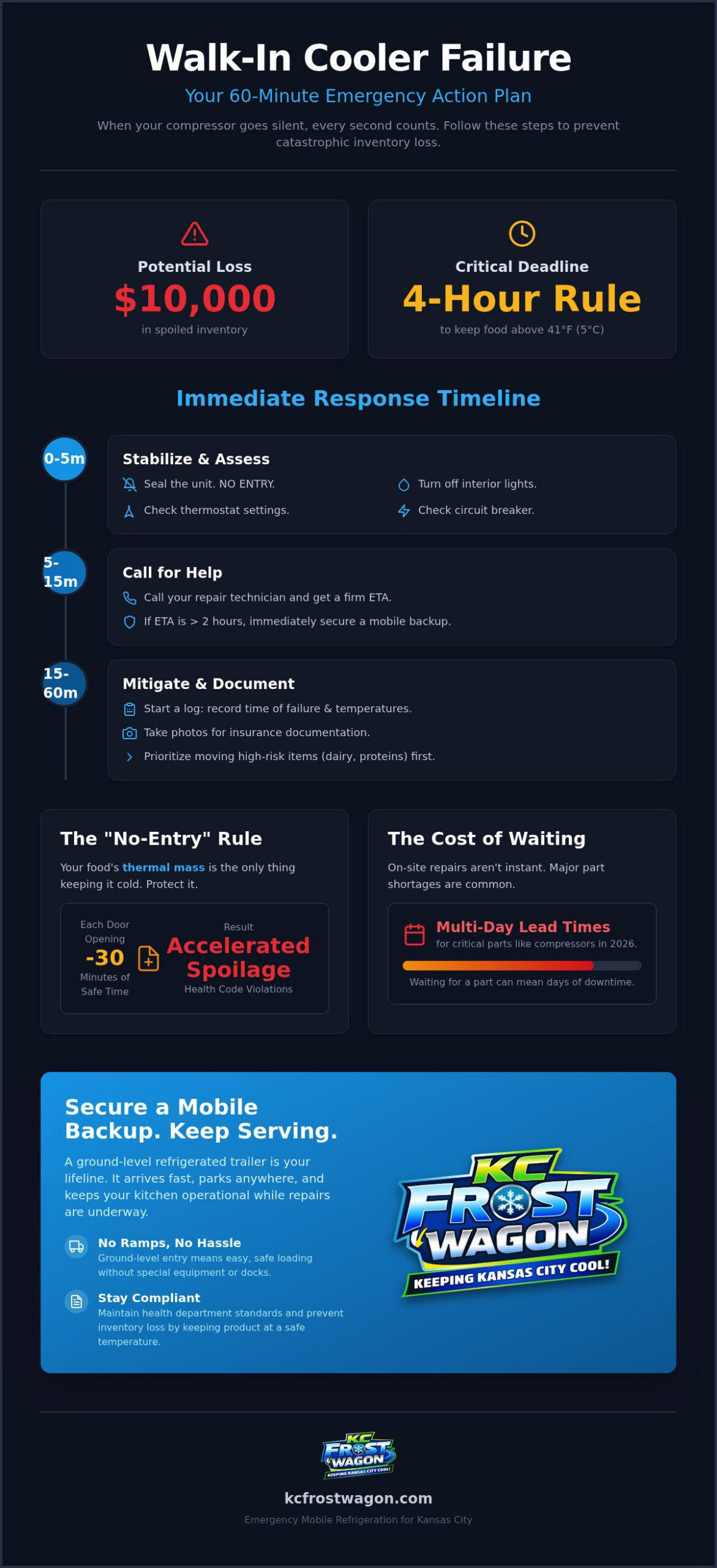
The first sixty minutes determine whether you lose a few hundred dollars in labor or ten thousand dollars in inventory. Follow this immediate checklist to stabilize the situation:
- Seal the unit. Close the door and don’t open it again. Every time the seal is broken, you lose roughly 30 minutes of safe storage time.
- Kill the lights. Lightbulbs generate heat. It seems minor, but in a sealed environment, every degree matters.
- Call your technician. Get a firm ETA. If they can’t be there within two hours, you need a secondary plan.
- Phone a backup provider. Contact a mobile refrigeration service before your internal temperature hits 38°F. Waiting until you hit 41°F is too late.
The “No-Entry” Rule: Preserving Thermal Mass
Your cooler stays cold because of thermal mass. In food safety, thermal mass refers to the collective cold energy stored within your bulk products and liquids that resists temperature changes. When your walk-in cooler broke down, this mass became your primary cooling source. Understanding how refrigeration works helps you realize that once the mechanical cycle stops, you are relying entirely on the insulation and the existing cold items to maintain safety. Tell your staff to use reach-ins or prep-table coolers only. No one enters the walk-in without manager approval. If a cook “just needs one onion,” they are sacrificing the safety of the entire inventory for a single garnish.
Documentation for Insurance and Health Inspectors
You need a paper trail to protect your business. Start a manual log immediately. Record the exact time of the failure, the starting temperature, and the current ambient temperature of your kitchen. High humidity or a 90-degree kitchen will accelerate your loss, so document these conditions. Take clear photos of the thermostat and your inventory levels. Insurance providers require proof of “reasonable effort” to mitigate loss. If you can show you monitored the rise and attempted to secure backup cooling, your claim is much more likely to be approved. Health inspectors also want to see that you didn’t guess when the food hit the 41°F threshold. Precision is your best defense.
Quick Troubleshooting: Is It a Simple Fix or a Total Failure?
Before you commit to a major repair bill, perform a quick triage. Is it a total system failure or just a minor hiccup? A diagnostic fee alone usually runs about $120. Finding the problem yourself in five minutes could save you that fee and hours of stress. Walk to your unit and listen. A healthy compressor has a steady hum. If you hear a rhythmic clicking or total silence, your walk-in cooler broke down at the mechanical level. Don’t forget to verify the thermostat settings. It’s easy for a staff member to accidentally bump the dial during a busy shift, turning the unit off or setting the target temperature too high.
Power and Electrical Basics
Start with the obvious. Check your circuit breaker panel. A power surge can trip the compressor even if the interior lights stay on. This “ghost power” scenario is common and easily fixed with a flip of a switch. Locate your manual disconnect switch near the unit and ensure it hasn’t been accidentally toggled. However, if the breaker trips again immediately, stop. Persistent electrical issues suggest a short circuit or a failing motor. Don’t risk a fire or further damage; wait for a licensed professional. Following food safety during a power outage protocols is vital while you wait for the pro to arrive. Standard labor rates for technicians range from $150 to $250 per hour, so clear the area before they arrive to save them time and save you money.
Airflow and Condenser Issues
Airflow is the lifeblood of refrigeration. Look inside the cooler. Are boxes stacked to the ceiling? If you block the evaporator fans, the unit can’t circulate cold air. This often leads to frozen coils, especially during a humid Kansas City summer. Check the external condenser unit as well. Dust and kitchen grease act as insulation, forcing the system to work twice as hard. If the coils are caked in grime, the system will eventually overheat and shut down. Minor issues like sensor replacements might only cost $150 to $400, but neglecting airflow can lead to a $4,500 compressor replacement. Use a flashlight to peek behind the fans. If you see a wall of white ice, the unit needs a manual defrost cycle before it can pull the temperature back down.
If your troubleshooting reveals a frozen coil or a dead motor, you need a temporary solution while the unit thaws or parts arrive. If your walk-in cooler broke down and won’t restart, we can have a commercial backup refrigeration trailer on-site quickly to protect your stock. Don’t let a simple airflow issue turn into a total inventory loss while you wait for a technician to clear their schedule.
The True Cost of Waiting: Why Refrigeration Repair Isn’t Instant
Your walk-in cooler broke down, and you’ve called the best technician in Kansas City. You probably expect a fix by the dinner rush. Reality is often much harsher. Even with a “24/7” service contract, a technician might arrive quickly but leave without fixing the problem. Understanding the total cost of equipment failures involves more than just the repair invoice. It’s a calculation of lost sales, wasted labor, and the potential for a $10,000 inventory write-off. If your compressor is dead, you aren’t looking at a two-hour fix. You’re looking at a multi-day crisis.
The “Part Gap” is a persistent reality in 2026. While logistics have improved, major components for brands like Hobart or True still carry lead times of three to five days. Technicians don’t carry commercial compressors on their trucks; they have to order them from regional hubs. During this waiting period, your inventory is a ticking time bomb. You also face emergency labor rates that range from $150 to $250 per hour. Paying a premium for a tech to tell you the part is out of stock doesn’t save your steak or seafood. It just adds to the financial bleed.
The Reality of Emergency HVAC Dispatch
A “24/7 Service” tag doesn’t guarantee an immediate solution. It guarantees a diagnostic visit. The difference is critical. A technician can identify a failing fan motor or a refrigerant leak in thirty minutes. However, if the fix requires a specific controller or a high-capacity compressor, they are at the mercy of supply chains. Most repair trucks stock universal parts, but commercial walk-ins often require specialized components that aren’t sitting in a local warehouse. If your walk-in cooler broke down on a Friday night, you might not see that part until Tuesday morning. Can your inventory wait that long? Probably not.
Inventory Value vs. Rental Investment
Every business has a “Loss Threshold.” This is the point where the value of your perishable stock far exceeds the cost of temporary cooling. A fully stocked commercial walk-in can easily hold $5,000 to $15,000 in product. Compare that to the cost of a weekly trailer rental. It’s a small fraction of the potential loss. Beyond the food, consider the health department risk. A single critical violation for improper temperatures can lead to immediate disposal orders and reinspection fees of $200 to $500. Securing a 24/7 Emergency Refrigeration Rental is about more than just temperature. It’s about maintaining your reputation and keeping your doors open while the repair technician waits for a delivery truck.
Strategic Inventory Transfer: Moving Product Safely
The trailer is leveled. The power is hummimg. Now the real work begins. Moving thousands of dollars in stock requires a tactical system, not a frantic scramble. If your walk-in cooler broke down, you can’t afford a disorganized transfer. Every minute a crate sits on a hot loading dock is a minute closer to a total inventory loss. Stage your move before you open the cooler door. Keep the mobile unit as close to the exit as possible to minimize exposure to ambient air. Use speed racks and heavy-duty carts to move items in bulk. This keeps the products grouped together, allowing them to maintain their own thermal mass during the transition.
Speed is essential, but safety is the priority. Assign one team member to stay inside the trailer to organize, while others shuttle the product. This prevents the trailer door from being left open, which would compromise the temperature of the items already saved. Remember that you are moving through a kitchen that is likely still operating. Clear the pathways and ensure your team has a clear “hot line” to the dock. If you’re currently in the middle of a crisis, you can rent a mobile cooler immediately to begin this process before the temperature hits the danger zone.
The “High-Risk” Priority List
Your inventory has a hierarchy of vulnerability. Seafood and raw poultry are your absolute primary concerns. These items have the shortest window before bacteria growth reaches unsafe levels. Move them first. Next, focus on raw red meats, dairy, eggs, and prepared sauces. Hard cheeses, fresh produce, and sealed condiments are more resilient; they can wait until the high-value proteins are secure. Maintaining the cold chain is vital during the 50-foot walk from your kitchen to the unit. If you’re moving product through a humid Kansas City afternoon, every second of exposure counts. Don’t let a $500 flat of scallops sit in 90-degree heat while someone looks for a lost pallet jack.
Organizing Your Temporary Cold Storage
Don’t treat your rental like a storage closet. A packed trailer with zero airflow won’t maintain the required 38°F. Leave at least three to four inches of space between the walls and your crates to allow the evaporator fans to circulate air properly. Organize the interior by station or prep list. If your line cooks can find the prepped ribeye in five seconds, they won’t leave the trailer door hanging open for five minutes. Label every shelf clearly. Continue using the “First In, First Out” (FIFO) method even during this emergency. Our 6×16 freezer trailer for rent provides enough interior workspace to stay organized while your kitchen remains fully operational. Because our trailers sit at ground level, your staff won’t have to navigate dangerous ramps or loading docks while carrying heavy crates of inventory.
24/7 Emergency Refrigeration in Kansas City: We Are Already En Route
Crisis doesn’t check the clock. If your walk-in cooler broke down in the middle of a Friday night rush, you can’t wait for a national provider to dispatch from three states away. You need a local partner who knows the Kansas City metro and understands the urgency of a failing compressor. We provide more than just a trailer; we provide a lifeline. We know that every minute of downtime costs you money, staff morale, and your reputation. Our team is built for speed and reliability, ensuring your inventory stays at the perfect temperature regardless of the heat outside.
Our operation is designed to remove the logistical burden from your shoulders. When your equipment fails, you have enough to manage in the kitchen. We handle the delivery, the positioning, and the technical setup. Your inventory is safe. Your business stays open. Peace of mind is just a quick phone call away.
Local Kansas City Response Times
We are a local Kansas City operation. This means we can often be on-site in Overland Park or Olathe while your repair technician is still checking their GPS. We serve the entire metro area, including Lee’s Summit, Independence, and the Northland, with 24/7 dispatch. When that brutal KC summer humidity hits 90% and your system stalls, we move fast. We bridge the gap between failure and repair with our Emergency Refrigeration Rental service. Being local means we aren’t just a voice on the phone; we are your neighbors ready to save your stock.
Ready-for-Anything Equipment
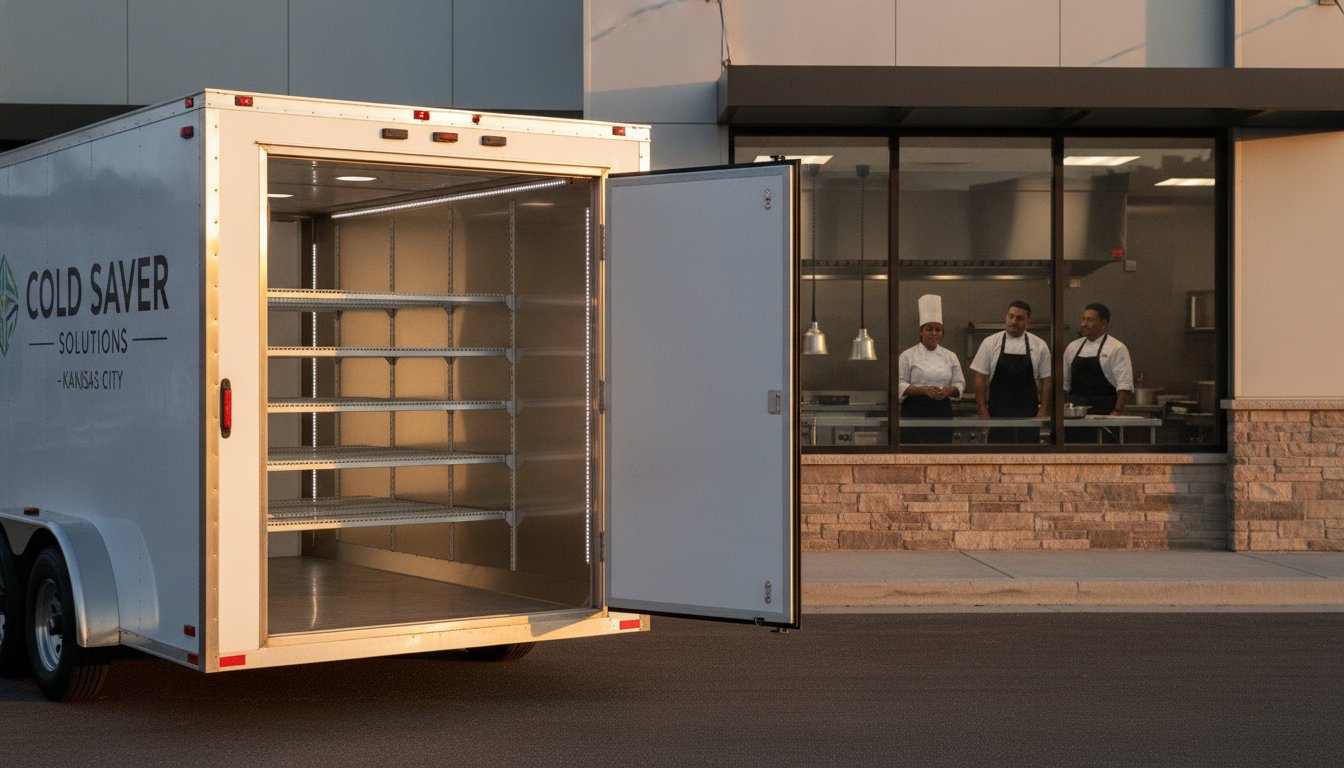
Our fleet is built for the specific demands of commercial kitchens. We offer 6’x12’ and 6’x16’ units that fit comfortably in standard parking spaces or behind your building. Unlike massive national reefer trucks that require a loading dock, our trailers feature ground-level access. This is a game-changer for safety. Your staff won’t have to navigate steep, slippery ramps while carrying heavy crates of raw protein. They can walk right in and out with ease, keeping the kitchen workflow moving.
Each unit is engineered for versatility. They feature dual-temp capability, allowing you to switch between cooler and freezer modes with a simple setting change. Powering them is easy. Our trailers run on a standard 110v outlet or are completely generator-ready if your building has lost power. They are cleaner, quieter, and far more reliable than old semi-trailers. You can rent a refrigerated trailer in under 10 minutes. We arrive, we set up, and we let you get back to work. Don’t let a breakdown break your business.
Stop the Clock and Save Your Kitchen
The first sixty minutes are behind you. You’ve sealed the unit and triaged the power. Now comes the decision that determines your bottom line for the month. Don’t let the “Part Gap” turn a minor mechanical failure into a total inventory write-off. When your walk-in cooler broke down, you entered a race against spoilage that you can’t win with prayer alone. You need a tactical backup that arrives faster than a technician’s specialized compressor order.
We are the local experts you call when the stakes are highest. Our 24/7 emergency dispatch is always ready to roll across the entire Kansas City metro. We provide ground-level 6×16 trailers that eliminate the need for dangerous ramps or loading docks. We handle the heavy lifting and the logistics while you focus on your staff and your customers. Your reputation is safe. Your inventory is cold. Your doors stay open.
Save Your Inventory Now: Call for 24/7 Emergency Refrigeration
You’ve got this. Take the next step and let us handle the temperature while you handle the kitchen.
Frequently Asked Questions
How long will a walk-in cooler stay cold after a breakdown?
A sealed walk-in cooler will typically stay below the safe 41°F threshold for 4 to 6 hours. This window depends heavily on your current thermal mass and how well the door seals remain closed. If your walk-in cooler broke down and you keep the door shut, the insulation buys you a narrow window of safety. However, once that door opens, you lose cold air instantly and accelerate the warming process.
What is the safe temperature limit for refrigerated food?
The critical safe temperature limit for refrigerated food is 41°F (5°C). According to health safety standards, any perishable food that spends more than four hours in the danger zone between 41°F and 135°F must be discarded to prevent foodborne illness. Some local health codes are even stricter, requiring disposal after only two hours of exposure to these temperatures. Monitoring this threshold is vital for compliance.
Should I use dry ice in my walk-in cooler during a failure?
Using dry ice in a walk-in is generally not recommended. It releases carbon dioxide gas which can be dangerous for staff in confined spaces, and the extreme cold can damage your cooler’s floor or freeze products that shouldn’t be frozen. It’s much safer and more effective to move your high-value inventory into a dedicated mobile refrigeration unit that maintains a steady, controlled temperature without the risks of CO2 buildup.
Is a walk-in cooler breakdown covered by business insurance?
Most commercial policies cover inventory loss if you have a spoilage endorsement. To successfully file a claim, you must prove that the walk-in cooler broke down due to a covered cause and that you made a reasonable effort to save the stock. Documentation of your emergency response, including photos of the thermostat and manual temperature logs, is essential to prove you attempted to mitigate the financial loss.
How fast can an emergency refrigeration trailer be delivered in Kansas City?
We offer 24/7 emergency dispatch across the entire Kansas City metro area. Because we are a local operation, we can often have a trailer on-site within a few hours of your call. Our goal is to arrive and set up before your internal temperature hits that critical 41°F mark. This rapid response is designed to ensure you face zero inventory loss while waiting for a repair technician.
Can I run a freezer trailer off a standard outdoor outlet?
Yes, our mobile trailers are designed to run on a standard 110v, 20-amp outdoor outlet. You don’t need a specialized electrical hookup or a commercial electrician to get our units running. This simplicity allows for immediate deployment in any parking lot or loading dock. If your building power is out completely, our trailers are also fully compatible with portable generators to keep your inventory frozen or cold.
What are the most common causes of walk-in cooler failure?
The most frequent causes of failure are compressor burnout, faulty thermostats, and refrigerant leaks. Compressor issues are the most expensive, often costing between $2,000 and $4,500 to replace in today’s market. Other common problems include iced-over evaporator coils due to high humidity or grease buildup on the external condenser units. Regular maintenance can prevent many of these issues, but mechanical failures can still happen without warning.
How much inventory loss is typical during a 24-hour cooling outage?
A single 24-hour cooling outage can result in $2,000 to $10,000 in discarded food for a typical commercial kitchen. Beyond the raw cost of the product, you also face potential health inspection fines and the loss of revenue from being unable to serve your menu. The investment in a temporary rental is a small fraction of these potential losses, providing an immediate solution to protect your profit margins.

