
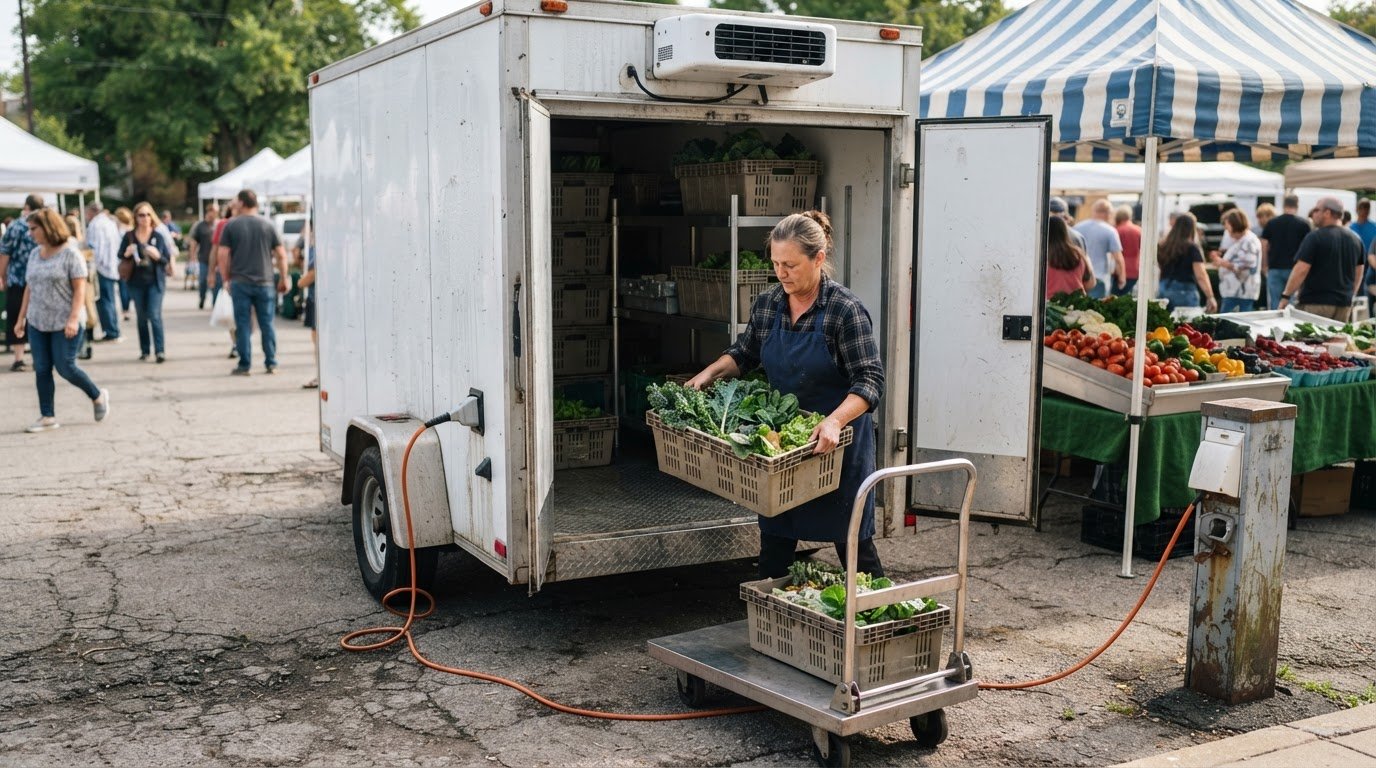
Keep cold time/temperature control for safety (TCS) foods at 41°F or below. For Kansas City sellers, that’s the practical starting point for choosing cold storage for outdoor market vendors, whether you’re protecting produce, prepared foods, or ingredients through a busy market day.
It’s not just about finding a cold unit. You need enough room for your products, a plan for overnight refrigeration, and a power setup that suits the market site. This guide explains what to consider when sizing storage, planning for electrical needs, and keeping products organized with room for airflow. You’ll also learn how temporary refrigerated storage can support a market day, seasonal rush, or larger event. With the right setup, you can spend less time worrying about temperature and more time serving customers.
Key Takeaways
- Plan to keep cold TCS foods at 41°F or below, and choose storage that can maintain the temperature your products need.
- Size capacity around the amount and type of product you’ll store, plus the space needed for access and airflow.
- Include overnight refrigeration in the plan so products remain cold between market days.
- Confirm the site’s power setup: the stated requirement is a dedicated, non-GFCI, 20-amp circuit.
- For produce, suitable cold storage can help preserve freshness and reduce the need to harvest immediately before selling.
1. Temperature ranges for chilled and frozen storage
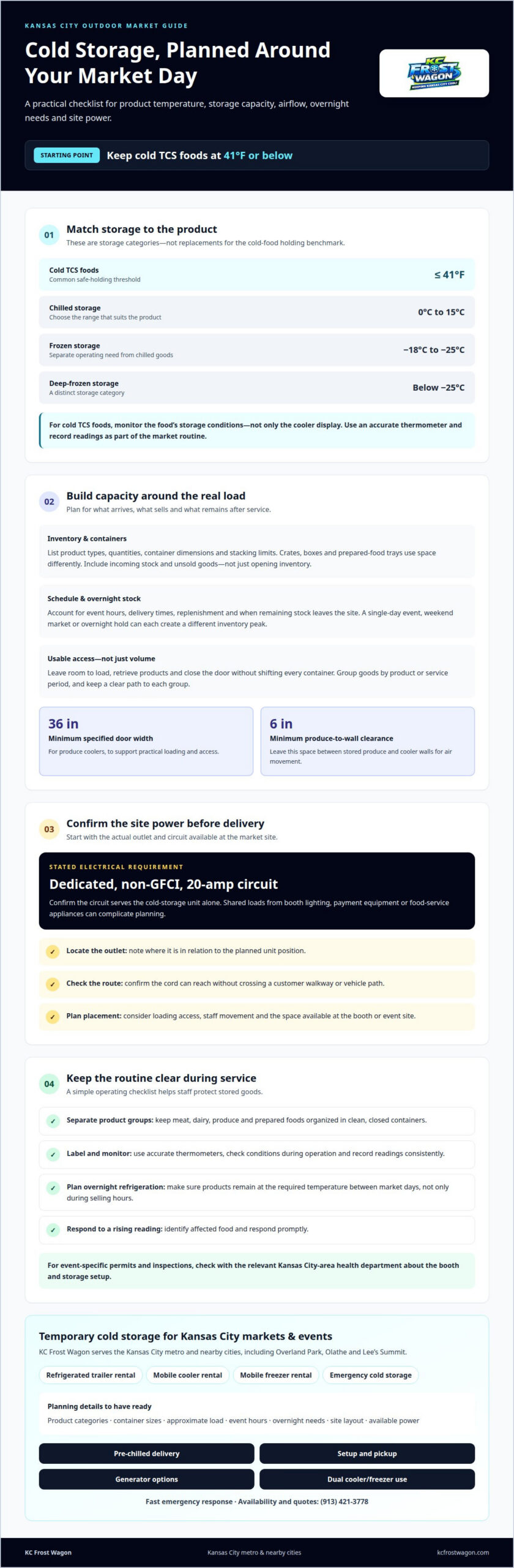
For cold TCS foods, use 41°F or below as the common safe-holding threshold. Keep that target in view when planning cold storage for outdoor market vendors in Kansas City. Chilled and frozen storage are different operating needs. Choose the range that matches each product, not simply the coldest setting available.
The report’s chilled range is 0°C to 15°C. Its frozen range is -18°C to -25°C, while deep-frozen storage is below -25°C. These ranges describe storage categories, not substitutes for the cold-food holding benchmark. A vendor serving prepared foods, for example, needs to manage food at 41°F or below.
For cold TCS foods, maintain 41°F or below and monitor the storage temperature. Place an accurate thermometer where it helps track conditions, then record readings as part of the market routine. Produce coolers should also have one or more accurate thermometers. A steady reading helps reveal a temperature change before it affects stored goods.
What FDA Food Code rules apply to temporary outdoor food vendors? The practical cold-holding benchmark is 41°F or below for cold TCS foods. Apply that target to the food being held, rather than relying only on a cooler’s display.
What local health permits and inspections are required for market cold storage? Requirements depend on the event jurisdiction and the type of operation. Ask the relevant Kansas City-area health department about rules for your booth and storage setup.
Transport meat, dairy, produce, and prepared foods in clean, closed containers, then move them promptly into storage suited to each product. Keep product groups organized to reduce cross-contamination. Separate handling zones make it easier to retrieve dairy or prepared dishes without disturbing other goods.
Overnight refrigeration matters when products remain at the market between service periods. Plan for storage to maintain the required temperature throughout that time, not just during selling hours. Temperature-controlled warehousing away from the event site may suit inventory stored elsewhere, but market-day stock still needs practical access and temperature monitoring.
Security and monitoring go hand in hand. Control access, check the thermometer during operation, and record readings consistently. If a reading rises above the target, identify affected food and respond promptly. Proper temperature management can help reduce spoilage, cross-contamination, and pathogen growth.
Choose storage based on your most temperature-sensitive products, service schedule, and whether stock stays overnight. Produce may need chilled conditions, while frozen products require a separate frozen range. Clear labels and recorded readings help staff follow the storage plan.
How a provider sizes cold storage for outdoor market vendors
Start by listing your products, quantities, and market schedule. A produce seller’s needs differ from a caterer’s prepared-food inventory. Account for what arrives, what sells, and what must stay overnight. This gives you a more useful capacity plan than choosing a unit by its exterior dimensions alone.
Map the load by container and storage type. Crates of greens, boxed dairy, and trays of prepared food use space differently. Container dimensions and stacking limits affect usable capacity. Plan chilled and frozen products separately because they need different temperature ranges. Include incoming stock and unsold goods, not just opening inventory.
Access matters as much as volume. Staff need room to place products, retrieve orders, and close the door without shifting every container. For produce coolers, the specified door width is at least 36 inches. The layout also needs at least 6 inches between stored produce and cooler walls. That clearance supports air movement and keeps products from pressing directly against surfaces.
Consider how often staff will access the unit. A busy market booth may need quick access to frequently used items. Grouping containers by product or service period can reduce searching and unnecessary handling. For example, a caterer can keep ready-to-serve trays together and separate ingredients for later preparation. Leave a clear path to reach each group.
Market timing changes the capacity calculation. A single-day event, weekend market, and overnight storage period create different inventory peaks. Account for delivery times, replenishment, and when remaining stock leaves the site. A produce vendor expecting daytime deliveries needs room to access incoming crates. A wedding caterer holding finished dishes may need space reserved until service.
Outdoor placement also shapes your plan. Consider where the unit can sit, how staff will approach it, and whether the location supports loading. A tight stall may need a different arrangement from a festival service area. These details help connect the storage layout to how people move around the booth.
Useful planning details include product categories, container sizes, approximate load, event hours, and overnight needs. A clear inventory description helps a provider size storage around the actual work, not a guess. For Kansas City market or event planning, a cold-storage quote request can start with those details and the site layout.
What electrical outlet and circuit requirements should a provider confirm for outdoor market cold storage?
Start with the site’s available power, not an assumed outlet. The stated requirement for the cold-storage unit is a dedicated, non-GFCI, 20-amp circuit. A provider should confirm that this circuit serves the unit alone. Shared loads can complicate planning, especially when a market booth also runs lights, payment equipment, or food-service appliances.
Next, identify the outlet location and the route to the storage unit. A provider needs to know whether the cord can reach without crossing a customer walkway or vehicle path. For example, an outlet behind a vendor tent may not work if the unit sits across an active aisle. Site maps and setup layouts help establish a safe, practical placement before event day.
Confirm the power source with the market organizer or site electrician. They can identify the circuit, its rating, and any restrictions for the event space. A provider can then plan the cold-storage setup around that information. Don’t assume a nearby receptacle is dedicated just because it appears unused. Confirming the circuit prevents relying on an outlet that may also serve other equipment.
A generator can be an option where fixed power isn’t suitable. The generator recommendation in this plan is at least 4,000 watts of running capacity for the unit. Running capacity matters during operation, so the provider should match the generator plan to the storage equipment and site conditions. A generator also needs a placement plan that keeps it accessible without blocking loading or customer traffic.
For a Kansas City festival, share the site map, outlet location, and event schedule with the provider. Include any equipment planned for the same area, such as serving lights or a point-of-sale system. The provider can use those details to coordinate a dedicated circuit or generator option and position the unit close enough for practical access.
Plan for power during setup and operating hours. Confirm when the outlet will be available, any site restrictions, and how overnight access works. If refrigeration must continue after vendors leave, the power arrangement needs to remain in place. A connection available only during the day will not support overnight storage.
Before delivery, the provider should align the electrical plan with the venue’s setup instructions. If the specified circuit or generator arrangement cannot be accommodated, adjust the placement or power plan before loading food. For a market or event in the Kansas City area, use a cold-storage planning request to share the site’s power details.
5. Cold storage benefits for produce vendors
Freshness affects how produce looks, handles, and sells at a Kansas City market. Cold storage can help preserve quality for an additional few days, giving growers more flexibility between harvest and sale. That can matter when market timing, customer demand, or delivery schedules don’t line up neatly.
Cold storage can also affect harvest planning. Without storage, a grower may feel pressure to pick perishable crops just before delivery or market day. Refrigerated storage can ease that pressure, making it easier to schedule harvesting around available labor and market dates. A vendor preparing for a Saturday market, for example, can manage picked produce before the event instead of relying entirely on last-minute harvesting.
Produce varies in how it should be handled and stored. Organizing leafy greens, berries, and root vegetables by type helps prevent rough handling and makes stock easier to find. Keep containers clean and dry, and avoid packing them so tightly that staff must crush or shift produce during retrieval. A clearly marked group of greens can be brought forward without disturbing delicate berries.
Cold storage slows microbial activity, which can reduce produce decay and the potential growth of human pathogens. It supports product quality but does not replace clean handling. Keep storage surfaces clean, protect produce from contamination, and remove damaged items promptly. Checking containers and rotating older stock helps staff spot problems before serving or displaying products.
Reliable holding conditions can also support a steadier market display. Replenish the table from stored stock as demand changes instead of putting the full supply out at once. A grower selling tomatoes and greens, for example, can keep reserve containers protected while displaying smaller quantities. This limits unnecessary handling and makes restocking more controlled.
Plan storage around the harvest and sales cycle. Track which crops arrive first, which need priority selling, and what remains after each market. A simple inventory list helps staff use older stock first and avoid overlooking containers at the back. These steps make it easier to coordinate harvest quantities with expected sales without treating every crop alike.
For seasonal vendors, temporary cold storage can support a busy event or a short-term increase in harvest volume. It keeps produce close to the market operation while the display area stays focused on customer service. Useful capacity depends on the crop mix, container sizes, and how often stock needs replenishing. Matching storage to these details helps preserve quality without disrupting sales.
5. What cold storage options work best for outdoor market vendors?
For short-term needs, renting a walk-in cooler can suit a large event or seasonal rush. It avoids buying equipment for a brief demand spike. Renting can also avoid ownership’s purchase, maintenance, and energy costs. For a Kansas City market, the choice depends on product volume, event duration, site layout, and access needs.
A rented cooler works best when vendors need secure, organized storage close to their selling area. Consider the products, containers, and order of use. A grower with crates of greens needs a different layout than a caterer storing boxed ingredients. Keep the route between the cooler and booth clear, so staff can retrieve stock without disrupting customer service.
Good interior design matters as much as capacity. Store produce off the ground, and choose surfaces that are easy to clean and dry. Leave room for passive air circulation around products. If containers create tight spaces, one or more fans can help move air through those areas. Avoid packing each shelf so tightly that staff cannot reach stock.
Drainage is another practical consideration. Excess water should drain away easily. For produce humidity, use lidded containers or clean coverings rather than wetting floors or walls. This helps prevent water collecting on surfaces and makes routine cleaning more straightforward.
Insulation affects how efficiently a cooler holds its set temperature. The guide recommends at least R-20 insulation for cooler walls. For a temporary market setup, placement and the event’s operating conditions also matter. A provider can factor in the site layout and storage needs when planning the suitable unit and setup.
Some vendors consider a room-based cooler made with an air conditioner and a CoolBot. That setup requires careful design, including a drain pitched outside and a setting that minimizes ice buildup on the fins. Cold-room walls, floors, and ceilings also need sufficient insulation, with a sealed vapor barrier on the warm side of the assembly.
For a one-time festival or seasonal sales peak, renting can be more practical than buying a walk-in cooler. For ongoing storage, the decision depends on how regularly the space is needed and the operational demands. The best option supports clean storage, easy product access, airflow, and drainage without crowding the market work area.
Planning a market, festival, or seasonal rush in the Kansas City area? Discuss temporary cold-storage needs and how they fit your event setup.
KC Frost Wagon
KC Frost Wagon helps Kansas City market vendors plan temporary refrigeration around their products and event schedule. Refrigerated trailer rental and mobile cooler rental support markets, festivals, and seasonal sales peaks. The 12×6 and 16×6 trailers can be used for cooler or freezer storage, and arrive pre-chilled for delivery and setup.
For planning, share what you’ll store, when the market runs, and the site’s power setup. Generator options are available, and setup and pickup are part of the rental service. KC Frost Wagon serves the Kansas City metro and nearby cities, including Overland Park, Olathe, and Lee’s Summit. For urgent refrigeration disruptions, 24/7 emergency refrigeration can provide temporary cold storage support.
For a quote or availability, call (913) 421-3778 or contact KC Frost Wagon.
Prepare a storage plan your team can use
Turn your market logistics into a storage plan that fits how your team works. For cold storage for outdoor market vendors, connect inventory and service timing with site layout, power access, and overnight needs. A clear plan helps staff receive deliveries, locate products, and keep the selling area moving through busy periods.
Before the event, align the storage plan with staff responsibilities. Decide who receives incoming stock, who organizes products, and who handles closing procedures. Clear handoffs help prevent confusion when vendors are setting up or serving customers. Share the event schedule and site details with KC Frost Wagon so the conversation can focus on the storage arrangement for your market, festival, or seasonal rush.
Give your team a simple operating plan for the day, including access expectations and where stored products fit into service flow. That small planning step can help avoid last-minute layout changes. Plan your market cold storage with KC Frost Wagon. You’ll be better prepared to serve customers and keep the event running smoothly.
Frequently Asked Questions
What power sources can a provider offer for cold storage at outdoor markets?
A provider can plan around a dedicated 120 V outlet or an optional generator. The useful choice depends on where the unit will sit and how the venue supplies power. For example, an outlet near a vendor area may suit a fixed setup, while a generator option can help at a site without convenient outlet access. Include the proposed placement in the event layout.
What temperature requirements apply to cold holding food at farmers markets?
Follow the applicable cold-holding requirements for each food, and keep frozen products separate from chilled items. Organize different product types by category and retain their labels. For example, keeping dairy apart from produce makes stock easier to identify and handle. Include the market’s food-safety procedures in the vendor’s operating plan.
How can a provider monitor and record cold-storage temperatures?
Make sure staff know how to read the unit’s thermometer and record unusual changes. A useful log pairs each reading with the time, the person recording it, and any action taken. For example, note a door left open or a moved product load alongside the temperature entry. This creates a clear record for the next shift and supports a consistent response.
How can a provider help keep cold storage secure and weatherproof at outdoor markets?
Coordinate trailer placement with the venue layout and access arrangements. Ask the event organizer to identify an approved location that does not block aisles, service routes, or loading areas. For overnight markets, decide who can access the storage area and how staff will retrieve products. Share the site plan and event details with KC Frost Wagon before setup so the trailer fits the venue’s operating needs.
How long can food stay safely cold in coolers and portable refrigerators?
Cold TCS foods can be kept safely cold while they remain at 41°F or below. For overnight storage, refrigeration must maintain that temperature.
What are the risks of using ice, dry ice, or generators for outdoor cold storage?
The guide gives no specific risks for using ice or dry ice. For generators, it recommends at least 4,000 watts of running capacity and a placement plan that keeps the generator accessible without blocking loading or customer traffic.

