
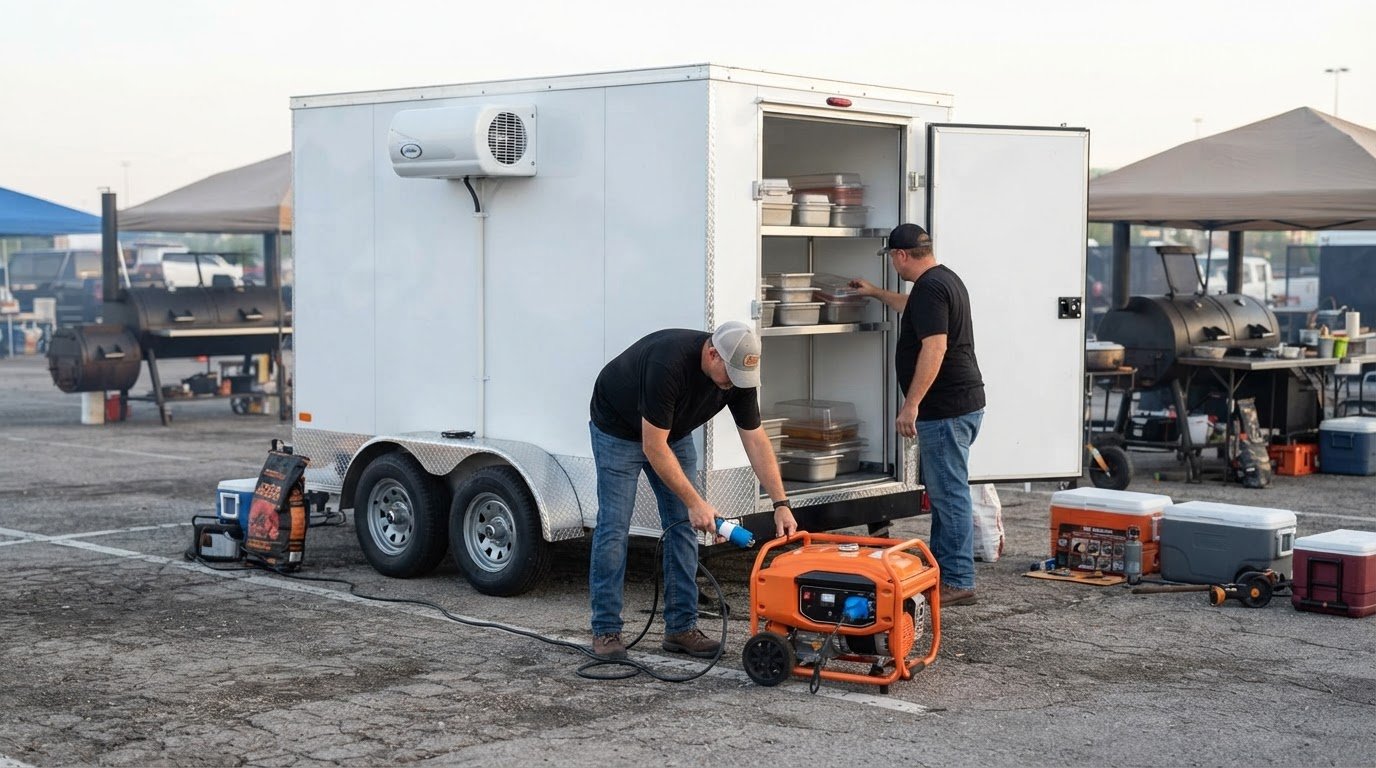
Competition day leaves little room for a cold-storage scramble. A BBQ competition cooler trailer in Kansas City can give a team dedicated space for ingredients and prepared items, while a practical power plan helps keep storage ready through the event. The details matter: what needs to stay chilled or frozen, where the unit will sit, and what utilities the site can support.
Food storage is a key part of a smooth competition setup. Plan how trailer capacity, cooler or freezer use, electrical access, and generator options will support your team at the KC BBQ Championship. Include delivery, setup, and pickup in your site plan so you can focus on prep, turn-ins, and the cook.
Key Takeaways
- Plan cold storage around your team’s ingredients, prep schedule, and the space available at the competition site.
- Match the trailer’s power needs to the event’s electrical setup, and consider a generator option when your power plan requires it.
- Keep meat storage organized by separating items for different stages of preparation and service.
- Compare the convenience of refrigerated trailer storage with the space and upkeep involved in using ice chests.
- Think through delivery, setup, and pickup as part of your event logistics, not as last-minute details.
Made for KC BBQ Championship
A barbecue competition is a cook-off where teams prepare entries for judging. In Kansas City, the Great Lenexa BBQ Battle is also known as the Kansas State Championship of barbecue. The event has been held since 1982, and its history shows how much team logistics can matter. It began with 12 teams and had grown to 168 competitors by 2022.
The Great Lenexa BBQ Battle is scheduled for June 25-26, 2027, at Sar-Ko-Par Trails Park in Lenexa. For teams preparing there, cold storage planning starts with the event schedule and the layout of the cook site. Separate competition ingredients from supplies intended for team meals. Keep commonly used items accessible, so cooks can retrieve them without disturbing other stored food.
KCBS categories are the meat divisions teams enter for competition. At Kansas City Barbeque Society-sanctioned events, teams submit entries in four meat categories. Each entry box must contain at least six portions, one for each of six judges. Organize ingredients by category and keep each group clearly identifiable during preparation.
Turn-in timing is another reason to plan storage access before cooking begins. At the Great Lenexa BBQ Battle, contestants begin submitting chicken entries at noon, with 30 minutes between the following categories. A team can use that sequence to map which ingredients and prepared items need to be reachable at each stage. Keep the next category’s supplies together rather than stacking them behind items for later use.
Grand Champion is the title awarded to the contestant with the highest score across all four KCBS meat categories. Since the result spans the full contest, treat cold storage as part of the entire cook plan, not a single-category task. Map out storage zones before loading: one for each competition category, plus separate space for team provisions if needed. Keep the next turn-in’s items easy to reach.
- Category grouping: Keep each category’s ingredients and supplies together for easier retrieval.
- Turn-in sequence: Use the Great Lenexa schedule to decide which category’s items need priority access.
- Team provisions: Separate team food from competition ingredients to reduce unnecessary handling.
At Sar-Ko-Par Trails Park, the cook site and competition schedule shape practical storage decisions. Before the event, plan a loading order: put items needed first within easy reach and keep supplies for later categories organized behind them. The Great Lenexa BBQ Battle’s four-category structure provides a useful framework. Organized cold storage helps keep preparation moving from the first entry through the final category.
later-category supplies can remain in a less prominent area until their turn approaches. The Great Lenexa BBQ Battle has been a Kansas State Championship since 1984. That championship role makes advance organization useful for teams balancing competition entries and team provisions. Recheck the plan before cooking starts, and adjust the placement of stored items when the order of work or access around the cook site changes.
What electrical hookup or generator is needed to run a cooler trailer?
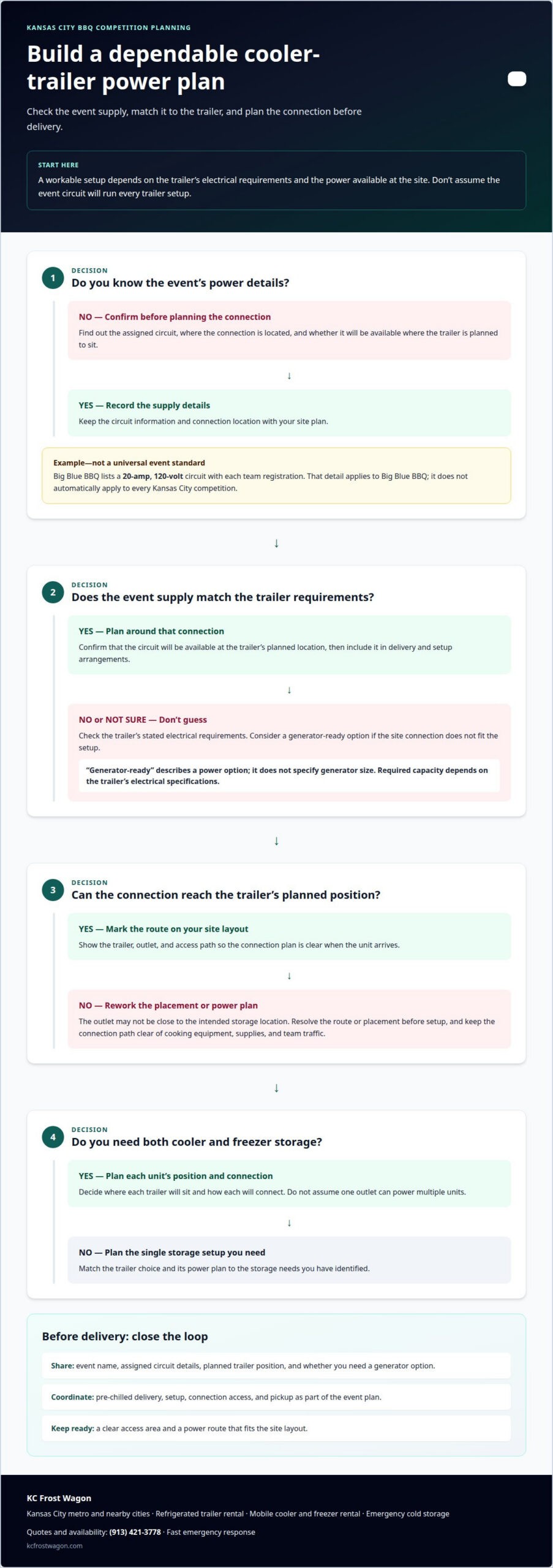
An electrical hookup is the event-provided circuit used to power equipment. The right connection depends on the trailer’s requirements and the site’s available power. At Big Blue BBQ, each team registration includes a 20-amp, 120-volt electrical circuit. That detail applies to Big Blue BBQ, not automatically to every Kansas City competition. Treat the event’s power plan and the trailer’s hookup requirements as a pair.
A generator is a separate power source used when a suitable site connection isn’t available. A generator-ready refrigerated trailer can support event planning where teams need to account for power away from a fixed hookup. Generator-ready describes a power option; it doesn’t tell you a specific generator size. The required capacity depends on the trailer’s electrical specifications, so don’t guess from the event circuit alone.
Start with the event’s power details. Identify the circuit assigned to your team, its location, and whether it will be available where the trailer is placed. For Big Blue BBQ, the stated team circuit is 20-amp, 120-volt. Then match that information against the trailer’s stated electrical requirements. If either side differs, plan around a compatible power source instead of assuming the event circuit will run every setup.
Map the trailer’s position and power route before it arrives. The outlet near your cooking area may not be close to the planned storage location, so include the trailer, outlet, and access path in your site layout. Keep the connection route clear of cooking equipment, supplies, and team traffic to make setup straightforward.
- Event supply: Record the circuit details and where the connection is located.
- Trailer requirements: Match the trailer’s electrical information to the event supply.
- Backup plan: Consider a generator-ready option if the site connection doesn’t fit the setup.
Power planning also determines where the trailer can go and how it fits into your event schedule. Include the connection plan in delivery and setup arrangements, and keep the access area clear. If you need both cooler and freezer storage, decide where each trailer will sit and how each will connect. Don’t assume one outlet can power multiple units.
For a Kansas City competition, share the event name, assigned circuit details, trailer placement, and whether you need a generator option when discussing your setup. These specifics help shape a practical power plan without relying on an assumed electrical rating. If you’re arranging a generator-ready trailer setup, include those details in your inquiry.
What food-safety temperature rules apply to meat stored in a competition cooler trailer?
Temperature control means keeping meat within the limits required for its storage stage. Follow the food-safety requirements for your operation and the competition’s instructions rather than guessing a temperature. The applicable limit may depend on whether meat is raw, cooked, or being held for service. A trailer’s control setting does not show the temperature of every item inside.
A thermometer lets you check temperature directly. Before loading, decide how your team will measure and record the temperature of stored meat. Check the product with a clean, suitable thermometer, following its instructions. An interior display can help monitor the trailer, but it does not replace checking the meat itself.
Keep raw meat separate from cooked or ready-to-serve food during storage. Use sealed containers and clearly marked zones. For example, keep raw brisket apart from cooked items prepared for later service. Keep utensils and hands used for raw products away from ready-to-eat food.
Organize storage by category and the order you’ll use items. At a KC barbecue contest, a team might keep brisket, pork, ribs, and chicken in separate zones. Labels can identify each product and its intended use, while a simple written log records checks and any corrective steps. The record helps the team track readings against its established limits during a busy prep schedule.
- Before loading: Confirm the applicable storage limits and prepare a way to record checks.
- During the event: Check product temperatures and note readings at planned intervals.
- If a reading is outside the limit: Separate the affected food and follow your food-safety procedure before using it.
Limit unnecessary door openings. When the cook schedule allows, retrieve ingredients in batches and close the door promptly. Gather what you need for the next preparation step instead of reopening storage repeatedly. Arrange containers so the next category is accessible without moving other food.
At a Kansas City competition, assign a team member to oversee temperature checks and logs. That person can communicate concerns to the cooks and keep the storage plan consistent across shifts. If a reading changes unexpectedly, record it, keep affected food out of use, and follow your operation’s established food-safety procedure. Clear roles and accurate records support a careful response during competition prep.
Apply the storage limits relevant to each meat’s stage, whether raw, cooked, or held for service, and follow the competition’s instructions. Check the meat itself at planned intervals and record readings. Keep food outside its applicable limit separate until you follow your food-safety procedure.
How far in advance should I reserve a cooler trailer for a Kansas City BBQ competition?
Reservation timing is how early you arrange cold storage for an event. Once your competition dates, site plan, and storage needs are clear, plan the rental. No single lead time fits every Kansas City BBQ competition. Timing depends on the event calendar, how many teams or vendors share the site, and the trailer setup your plan requires.
Start with the event schedule. For the Great Lenexa BBQ Battle, match the storage period to the contest days and your arrival and departure plans. Include setup time, ingredient delivery, and pack-out. A team arriving before its first cook needs a different storage window from one using cold storage only during competition hours.
Next, define what your storage plan needs to handle. List the meat and other food your team expects to bring, then distinguish cooler needs from freezer needs. Teams entering several categories may benefit from separate, easy-to-reach storage zones. Caterers supporting multiple teams should account for shared supplies and the time needed to load and organize them.
Site logistics can affect the reservation plan as much as the competition dates. Confirm where a trailer can be placed, how the team will reach it, and what power arrangement fits the site. If the event provides a specific electrical connection, include its details in your planning. If your layout calls for generator support or separate cooler and freezer use, factor those needs in early.
Use this sequence to organize the request:
- Set the event window: Include arrival, competition, and pack-out periods.
- Estimate storage needs: Group items by category and identify cooler or freezer use.
- Map the site: Note placement, access, and the planned power source.
- Share the plan: Provide the event name, dates, storage window, and setup details when arranging a quote.
For a Kansas City-area event, firm dates make planning easier, while changes to the site layout can affect trailer placement and setup. If your team’s schedule is still changing, gather the details you already know: event name, expected arrival window, food categories, and power plan. Update your plan when the organizer finalizes site instructions so the storage arrangements match the actual setup.
Plan cold storage alongside team registration, site access, and ingredient transport, rather than waiting until the cooking schedule is settled. This gives your team time to coordinate trailer placement and use with the rest of its Kansas City competition plan.
How do refrigerated trailers compare with ice chests for BBQ competitions
A refrigerated trailer provides powered storage, while an ice chest is an insulated container you can move by hand. For a Kansas City BBQ competition, compare how each fits your team’s loading routine, movement, and work area. The right arrangement depends on where supplies arrive, how often cooks need them, and whether storage must move during the event.
Loading is one practical difference. A trailer can serve as a central destination for bulk supplies arriving by vehicle. Ice chests can be loaded separately and carried closer to a prep station. For example, a team can stage containers beside its work area and transfer the appropriate items into each chest. That may simplify short trips, but it adds handling.
Distance matters during a long cook. If the trailer is parked away from the team’s station, cooks will need to walk there for supplies. Ice chests can sit closer, but may compete for space with prep surfaces, cooking equipment, and team traffic. Sketch the cook site before choosing: mark the smoker, prep area, storage location, and a clear route between them.
Access is another consideration in a shared competition setup. A trailer can act as one central storage point for several teammates, while separate ice chests can be assigned to individual cooks or stations. For example, a team could keep working supplies at one station and reserves elsewhere. Clear labels and assigned responsibility help prevent confusion during a busy shift.
Use these questions to compare the options:
- How far is storage from the work area? Consider the number of trips cooks will make.
- Who needs access? Plan for one shared point or separate station-level containers.
- How will supplies arrive? Match the storage method to your loading and unloading routine.
A combined setup can suit a team that needs bulk storage as well as supplies close at hand. Keep reserve items in the central storage area, then stage a smaller working selection near the cook. This can reduce repeated trips without filling the prep area with every container. Decide who will replenish the working supply and return unused items.
Choose based on the actual site, not just the equipment. A compact station may favor fewer containers, while a spread-out cook site may benefit from storage staged near different work areas. For help planning refrigerated storage around your BBQ competition setup, discuss your cold-storage needs.
KC Frost Wagon
KC Frost Wagon helps Kansas City BBQ teams plan event cold storage around their food, site layout, and power needs. Refrigerated trailer rental and mobile cooler rental can support competition prep, while 12×6 and 16×6 cooler/freezer trailers offer options for cooler or freezer use. Pre-chilled delivery, setup, pickup, and generator options help teams coordinate storage with event logistics across the Kansas City metro and nearby cities, including Overland Park, Olathe, and Lee’s Summit.
Share your event dates, location, storage needs, and power plan when requesting a quote. For planning help, call (913) 421-3778. To discuss your BBQ competition setup and check availability, contact KC Frost Wagon.
Put Your Competition Plan in Motion
Your cold-storage plan works best when it matches the way your team cooks. Before the event, bring your menu, storage priorities, site layout, and power details together. That gives you a practical starting point for renting a BBQ competition cooler trailer in Kansas City, with key logistics planned before setup day.
KC Frost Wagon can help align event cold storage with your competition needs. Share what you’re storing, when you need access, and how the event site is arranged. Those details help shape a practical rental plan for your team.
Ready to discuss your event? Contact KC Frost Wagon about your trailer needs to ask about availability and request a quote. A well-planned setup lets you focus on the cook and enjoy competition day with confidence.
Frequently Asked Questions
What BBQ competition cooler trailers are available in Kansas City?
KC Frost Wagon offers refrigerated trailers for cooler or freezer use. Cooler storage can support ingredients that need chilled holding, while freezer use suits items that need to remain frozen. Choose the configuration that fits your menu and storage plan. If your team needs both types of storage, explain how you plan to divide items when arranging the rental.
Where can I rent a refrigerated or freezer trailer for a BBQ competition in Kansas City?
KC Frost Wagon provides refrigerated and freezer trailer rentals for Kansas City metro competitions. For a team sharing supplies, have one coordinator gather the team’s storage needs and arrange the rental details. That keeps decisions about chilled and frozen items together, rather than leaving each cook to plan separate storage. The rental is temporary, so it can support an event without requiring a permanent installation.
What sizes and temperature ranges do BBQ competition cooler trailers offer?
The available trailer sizes are 12×6 and 16×6, with cooler or freezer use. Choose the size based on the amount and type of food your team plans to store. The trailer information describes cooler and freezer configurations rather than numerical temperature ranges. Use your food-safety plan to set appropriate storage targets, and monitor the food itself during competition prep.
What should I check when inspecting a rented cooler trailer before a competition?
Check the trailer’s electrical requirements against the event’s available circuit, and confirm its planned position and power access. Before loading, use a suitable thermometer to check the meat; an interior display alone does not verify every item’s temperature.

