
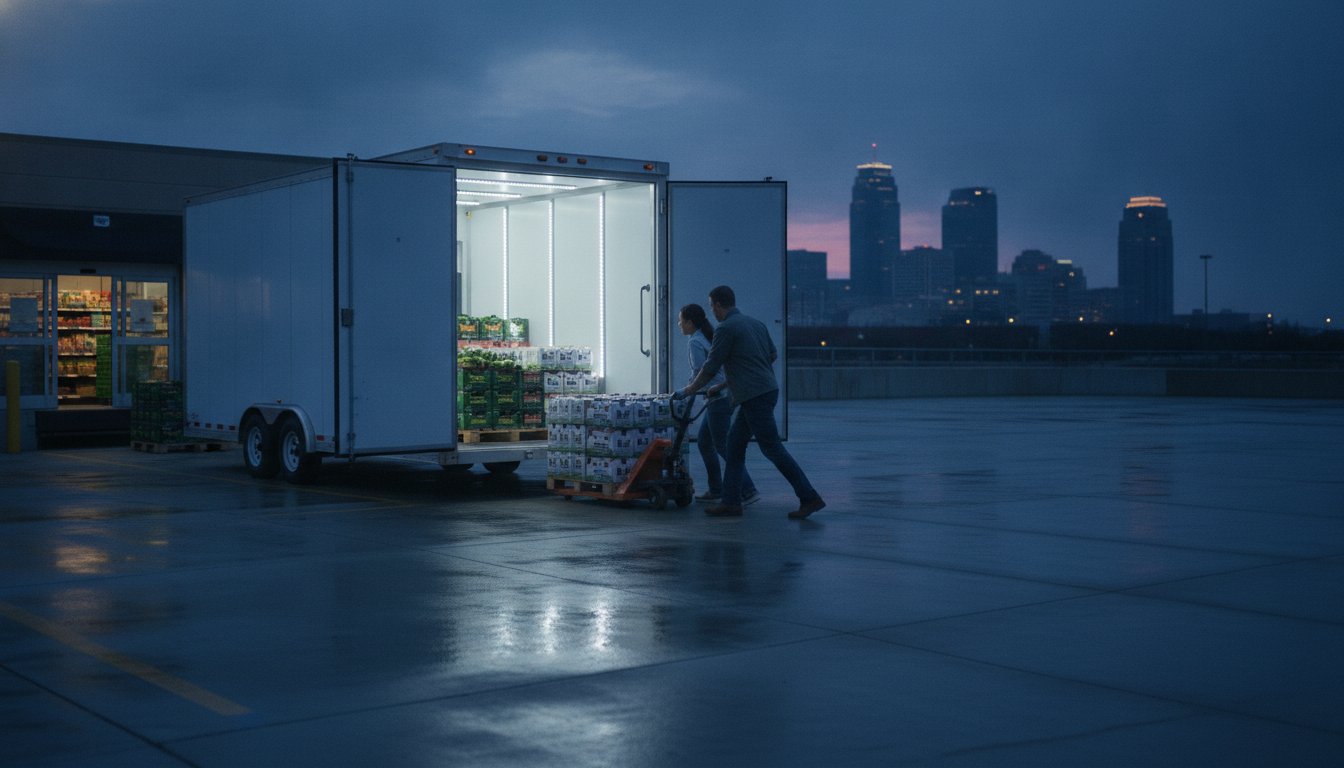
It’s 2 AM on a Tuesday when the temperature alarm on your main walk-in cooler starts screaming. You have thousands of dollars in prime beef and dairy products sitting in the danger zone, and every minute that passes brings you closer to a total inventory loss. When your primary cooling system fails, you don’t just need a repairman; you need immediate emergency cold storage for grocery store operations to protect your bottom line. Health department compliance won’t wait for a backordered part, and your customers expect fresh shelves by morning.
We understand that a refrigeration crisis is a logistical nightmare that threatens your reputation and your revenue. You shouldn’t have to scramble to move pallets to a distant warehouse or watch your profits go down the drain. This guide will show you how to deploy rapid-response refrigerated trailers that arrive on-site and stabilize your stock within hours. We’ll explore the benefits of ground-level access for easy pallet loading, the importance of guaranteed temperature stability, and why a mobile trailer is the fastest way to turn a potential disaster into a managed situation that keeps your doors open.
Key Takeaways
- Act fast to beat the four-hour “danger zone” window and keep your perishable stock compliant with health safety standards.
- Discover why mobile trailers offer faster deployment and a smaller footprint than heavy storage containers during a crisis.
- Learn how to optimize emergency cold storage for grocery store inventory using the versatile 6’x16’ trailer layout.
- Identify the specific 110v power requirements and NEMA plug types to ensure your backup unit is running the moment it arrives.
- Leverage 24/7 local support in Kansas City to secure your inventory without the logistical delays of big-box providers.
The High Cost of Grocery Equipment Failure
When a compressor dies, the panic sets in. It’s a race against time that most store managers aren’t equipped to win alone. Emergency cold storage for grocery store operations acts as a mobile lifeline, providing a temporary bridge between equipment failure and a permanent fix. It isn’t just a rental; it’s a strategic asset that prevents your profit from melting away. Without a rapid response, you’re looking at a total inventory wipeout that can take weeks to recover from.
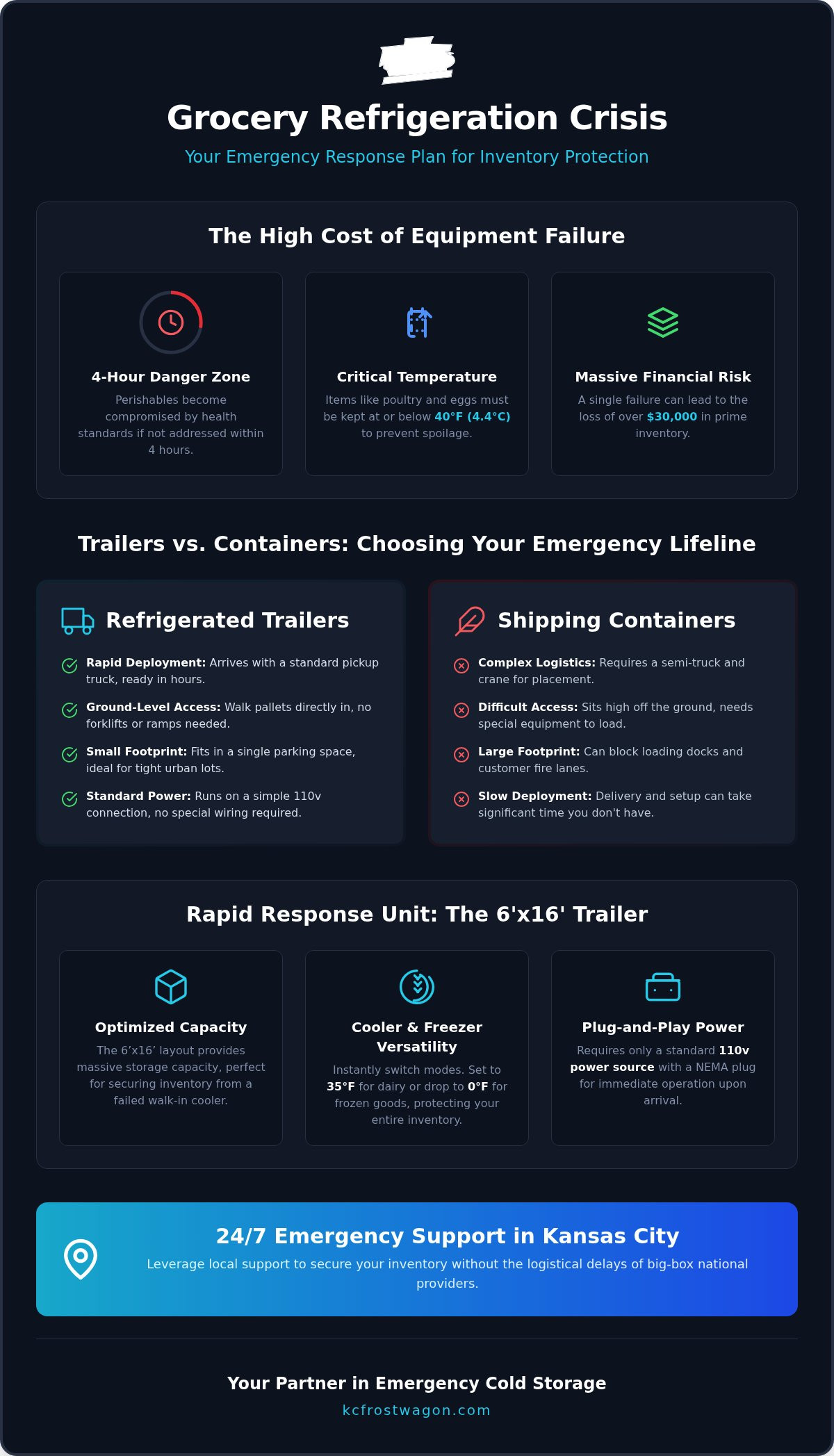
The math is simple but brutal. If you lose your primary cooling, you have exactly four hours before the health department considers your perishable stock compromised. A full freezer might buy you 48 hours if you keep the doors sealed, but in a busy grocery environment, that’s rarely an option. Comparing the cost of a daily trailer rental to the loss of $30,000 in prime cuts and organic dairy makes the decision easy. The return on investment is immediate because it saves the very products that drive your revenue.
The Vulnerability of Perishable Inventory
Your meat, dairy, and frozen departments are the heart of your store. They are also the most sensitive to temperature excursions. According to food safety regulations, perishable items like poultry and eggs must stay at or below 40°F. If these items sit in the “danger zone” above 40°F for more than two hours, they must be discarded. A single walk-in failure can trigger a massive financial blow, often exceeding the cost of the equipment repair itself. Maintaining the integrity of the cold chain is essential for both public safety and your brand’s reputation.
Why Traditional Repair Isn’t an Immediate Solution
Relying solely on a repair technician is a gamble. In 2026, lead times for commercial refrigeration parts remain unpredictable. Even if a tech arrives within hours, the specific motor or sensor you need might be days away. This is where the “triage” phase of grocery management begins. You have to stabilize your inventory before you can worry about the mechanical fix. Smart operators include a restaurant emergency plan for refrigeration in their playbook. Having a plan for emergency cold storage for grocery store needs means you aren’t begging for parts while your stock spoils. You simply move the product, plug in the trailer, and get back to business.
Trailers vs. Containers: Choosing Your Emergency Lifeline
When the cooling stops, the clock starts. You face a critical choice: a massive shipping container or a nimble refrigerated trailer. While containers offer high volume, they come with a logistical headache. They require a heavy semi-truck and a crane for placement. They need significant clearance and a reinforced surface. In a crisis, you don’t have time to coordinate a construction-level delivery. You need a solution that arrives on the back of a standard pickup truck and slides into a single parking space. This speed is why a mobile trailer is the gold standard for emergency cold storage for grocery store recovery.
Accessibility is the next hurdle. Shipping containers sit high off the ground, requiring ramps or forklifts for every load. In contrast, our trailers offer ground-level access. Your staff can walk pallets straight in without specialized equipment. This reduces physical strain and speeds up the transfer of sensitive stock. Every minute saved in loading is a minute closer to compliance with FDA food safety guidelines. Speed and ease of use are the differences between a successful save and a total loss.
The Agility of 6×12 and 6×16 Trailers
Space is a premium in Kansas City retail lots. A 6×16 trailer provides massive storage capacity without blocking your main loading docks or customer fire lanes. These units are designed for tight urban environments like Overland Park or downtown KCMO. They maneuver easily through narrow alleys where a 40-foot container would simply get stuck. Because they run on standard power or a small generator, you can place them exactly where you need them. This agility allows your store to remain operational while the trailer sits discreetly in a parking stall, quietly protecting your inventory.
When to Choose a Portable Freezer Trailer
Versatility is your best friend during a breakdown. Our units aren’t just coolers; they switch between cooler and freezer modes on the fly. If your frozen department fails, you can drop the temperature to 0°F instantly. If the dairy walk-in is the issue, set it to 35°F. This flexibility is vital for grocery stores with diverse inventory needs. If you aren’t sure which size fits your current crisis, comparing 6×12 vs 6×16 refrigerated trailers can help you match the unit to your specific pallet count. If your needs change, these units are easy to move between different store locations. For immediate help in the metro area, you can rent a refrigerated trailer that is ready to roll the moment you call.
Calculating Capacity: Will Your Inventory Fit?
Don’t guess when thousands of dollars are on the line. You need to know exactly how much your emergency cold storage for grocery store backup can handle. A 6’x16’ trailer offers a massive footprint for a mobile unit, supporting up to 6,690 lbs of inventory. This is enough capacity to save an entire meat department or a significant portion of your dairy walk-in. When every minute counts, knowing your capacity allows you to move with confidence rather than hesitation.
Vertical storage is the secret to maximizing space. Stack your dairy crates high, but keep the weight limits in mind. Our floors are engineered for commercial structural integrity, meaning they won’t buckle under the concentrated weight of heavy grocery loads. Use this checklist to prioritize your move:
- High-Value Proteins: Prime cuts and seafood come first.
- Organic Dairy: These high-margin items have zero tolerance for heat.
- Specialty Frozen Goods: Protect the items with the highest replacement cost.
- Deli and Prepared Foods: These are high-risk for health department red flags.
Pallet Capacity and Loading Logistics
Logistics shouldn’t be a bottleneck in a crisis. Our rear doors are designed to accommodate standard grocery pallets, allowing you to wheel stock directly inside using the ground-level access mentioned earlier. If you aren’t using pallets, interior shelving options keep your product organized and accessible. Crucially, don’t overstuff the unit. You must maintain airflow around the evaporator. If the air can’t move, the temperature won’t stay consistent, and you risk hot spots that compromise your stock.
Cooler vs. Freezer Mode Requirements
One unit does it all. Whether you’ve lost a freezer or a cooler, these trailers adapt to your needs. Pulling down to freezer temperatures takes time, so it’s best to start the unit immediately upon arrival. For mixed inventory, you might need to prioritize the coldest items first to maintain the thermal mass. Understanding these temporary cold storage solutions ensures you don’t waste precious time during the triage phase. We help you calculate the volume so you can focus on the save, not the math.
Preparation and Power Requirements for Rapid Setup
Speed is the only metric that matters during a cooling crisis. To ensure your emergency cold storage for grocery store backup is running the moment it hits the lot, you need to have your power source ready. Our trailers are designed for simplicity, but they require specific electrical parameters to protect the compressor and your inventory. Most units operate on a standard 110v circuit, requiring either 15 or 20 amps depending on the model. This “plug and play” capability is what makes trailers superior to heavy industrial containers that often require complex 480v three-phase power.
Placement is a balancing act. You want the trailer close to your store entrance to minimize the time food spends in the open air during the transfer. However, you must also be within reach of a dedicated power outlet. If your store is facing a total grid failure, these units are fully compatible with portable generators. This ensures your cold chain remains unbroken even when the lights are out. Identifying your NEMA 5-15 or 5-20 plug locations ahead of time can shave twenty minutes off your setup time; that’s an eternity when meat is warming up.
Electrical Safety and Compliance
A dedicated circuit is non-negotiable. Sharing an outlet with other appliances can lead to tripped breakers or voltage drops that damage the trailer’s cooling system. Never use standard household extension cords. They aren’t rated for the sustained draw of a commercial compressor and create a significant fire risk. Additionally, ensure your chosen placement is on a level surface. A level parking surface is necessary for proper drainage of condensation. A slight tilt can prevent drainage, leading to ice buildup or water pooling inside the unit, which compromises the sanitary conditions the health department expects.
The Delivery and Setup Checklist
When our team arrives, we handle the heavy lifting. The process moves fast: we position the unit, level the jacks, and secure the power connection. Once plugged in, the pull-down phase begins. You can monitor temperatures remotely during the rental to ensure total peace of mind without having to walk out to the lot every hour. For a deeper look at the transition from phone call to full operation, check out our guide on how to rent a refrigerated trailer. If you are in the middle of a breakdown right now, you can request emergency refrigeration delivery to get a trailer heading your way immediately.
KC Frost Wagon: 24/7 Emergency Support in Kansas City
When your walk-in dies at 3 AM, you don’t need a global logistics firm with a 1-800 number and a three-day waitlist. You need a local partner who understands that every hour of downtime is a blow to your business. KC Frost Wagon is that partner. We provide 24/7 emergency cold storage for grocery store owners who can’t afford to lose their inventory. As a local, family-owned operation, we don’t just see a client; we see a neighbor in a bind. Our rapid response protocol is built for speed. One call triggers an immediate dispatch. We skip the corporate red tape so your trailers arrive before your inventory hits the danger zone.
We pride ourselves on being the local heroes of the Kansas City refrigeration world. While big-box rental companies might take days to coordinate a delivery from a regional hub, we are already on the move. We offer flexible rental terms that adapt to your specific crisis. Whether you need a 24-hour bridge while a part is installed or a month-long solution for a major overhaul, we have you covered. Our goal is to remove the logistical burden so you can focus on running your store.
Serving the Entire Kansas City Metro Area
Distance is the enemy of fresh food. By keeping our fleet local, we slash response times across the entire metro. Whether you are in Overland Park, Olathe, or Lee’s Summit, our trailers are never more than a short drive away. This proximity is our greatest strength. While national competitors struggle with long-haul logistics, we are often on-site within hours. Our commitment to emergency refrigeration rental means we prioritize grocery crises to keep the local food supply safe. Local dispatch means local accountability. We know the streets, we know the traffic, and we know how to get to you fast.
Ready-to-Go 6×16 Freezer Trailers
Our 6×16 cooler/freezer trailers are the workhorses of the grocery industry. These units are specifically outfitted for heavy commercial use. They arrive clean, professional, and ready to work. You won’t find rusty, unreliable equipment here. A professional appearance matters when a unit is parked in front of your store. It tells your customers that you take food safety seriously. Don’t wait for the alarm to sound. Save our number now. Having a “Ready-for-Anything Expert” on speed dial is the best insurance policy for your emergency cold storage for grocery store needs. We handle the heavy lifting so your inventory stays frozen and your business stays profitable.
Protect Your Profits Before the Thaw
A refrigeration failure doesn’t have to be a financial disaster. By choosing mobile trailers over bulky containers, you gain the speed and ground-level access needed to save every pallet. You now know how to calculate your capacity and prep your power source for a seamless setup. The only thing left is ensuring you have the right partner on speed dial before the alarm sounds. Speed is the only metric that matters when your inventory is on the line.
KC Frost Wagon is ready to intervene when the stakes are highest. We provide emergency cold storage for grocery store operations with a focus on reliability and rapid deployment. Our local Kansas City experts are available 24/7 to deliver ground-level 6×16 units that fit your parking lot and your timeline. Don’t wait for the temperature to climb into the danger zone. We arrive fast so your business stays in motion and your shelves stay full.
Call KC Frost Wagon for 24/7 Emergency Cold Storage and get the peace of mind that comes with a professional backup plan. We handle the heavy lifting so you can focus on your customers. Your inventory is too valuable to leave to chance; let’s keep it cold together.
Frequently Asked Questions
How fast can you deliver an emergency cold storage unit to my store?
We offer 24/7 emergency response throughout the Kansas City metro. Because we are locally owned and operated, we can typically have a trailer on-site within hours of your call. Our goal is to beat the four-hour food safety window to ensure your perishable stock remains compliant. Whether you are in Overland Park or Lee’s Summit, our local dispatch protocol prioritizes grocery crises to minimize your downtime and prevent costly inventory spoilage.
Will a 6×16 freezer trailer fit in a standard parking space?
Yes, our 6×16 trailers are specifically designed to fit within the footprint of a single standard parking stall. This small footprint is a major advantage over large shipping containers that require massive clearance. You can place the unit near your entrance or loading dock without blocking fire lanes or customer traffic. This makes them ideal for tight retail lots in areas like downtown Kansas City or busy shopping centers in Olathe and Lenexa.
Can these trailers run as both a cooler and a freezer?
Every unit in our fleet is versatile enough to operate as either a cooler or a freezer. You can adjust the digital thermostat to maintain temperatures for dairy and produce or drop it down to 0°F for frozen departments. This flexibility is vital when you need emergency cold storage for grocery store departments that have different requirements. Our trailers provide stable, commercial-grade cooling regardless of the setting you choose for your inventory save.
What kind of power outlet do I need for a refrigerated trailer?
Our trailers are designed for plug and play simplicity using a standard 110v dedicated circuit. You will need a 15-amp or 20-amp outlet depending on the specific model delivered to your site. We provide the necessary commercial-grade power cords to ensure a safe connection. If your store is facing a total power outage, these units are fully compatible with portable generators, keeping your cold chain intact until the utility power returns to your building.
How much inventory can a 6×16 trailer actually hold?
A 6×16 trailer has a massive interior capacity and can support approximately 6,690 lbs of inventory. This is enough space to hold several standard grocery pallets or hundreds of individual dairy crates and meat cases. The interior height allows for vertical stacking, which helps you maximize every square inch of the unit. If you have a smaller overflow need, our 6×12 trailers are also available with a capacity of about 4,300 lbs for your stock.
Are these units accessible for loading pallets with a jack?
Yes, our trailers feature ground-level access and rear doors wide enough to accommodate standard grocery pallets. You don’t need a forklift or a loading dock to move your stock. Your staff can use a standard pallet jack to wheel inventory directly into the unit, which significantly speeds up the transfer process. This ease of loading is essential when you are racing against the clock to save high-value perishable goods during a walk-in cooler failure.
Do you offer 24/7 support if the rental unit has an issue?
We provide full 24/7 support for the entire duration of your rental. If you notice a temperature fluctuation or have any technical questions, our local Kansas City team is just a phone call away. We understand that grocery inventory is a high-stakes asset, so we remain on standby to intervene immediately. This level of dedicated, local service ensures that your emergency cold storage for grocery store backup remains reliable until your permanent system is repaired.
How long can I rent a portable cold storage unit for my business?
Our rental terms are completely flexible to match the timeline of your equipment repair. We offer daily rates for short-term crises and weekly or monthly options for situations where parts are on backorder for an extended period. Whether you need a unit for two days or two months, we can accommodate your schedule. We work with businesses across the KC metro to provide seamless transitions from emergency response to long-term backup for your store.

