
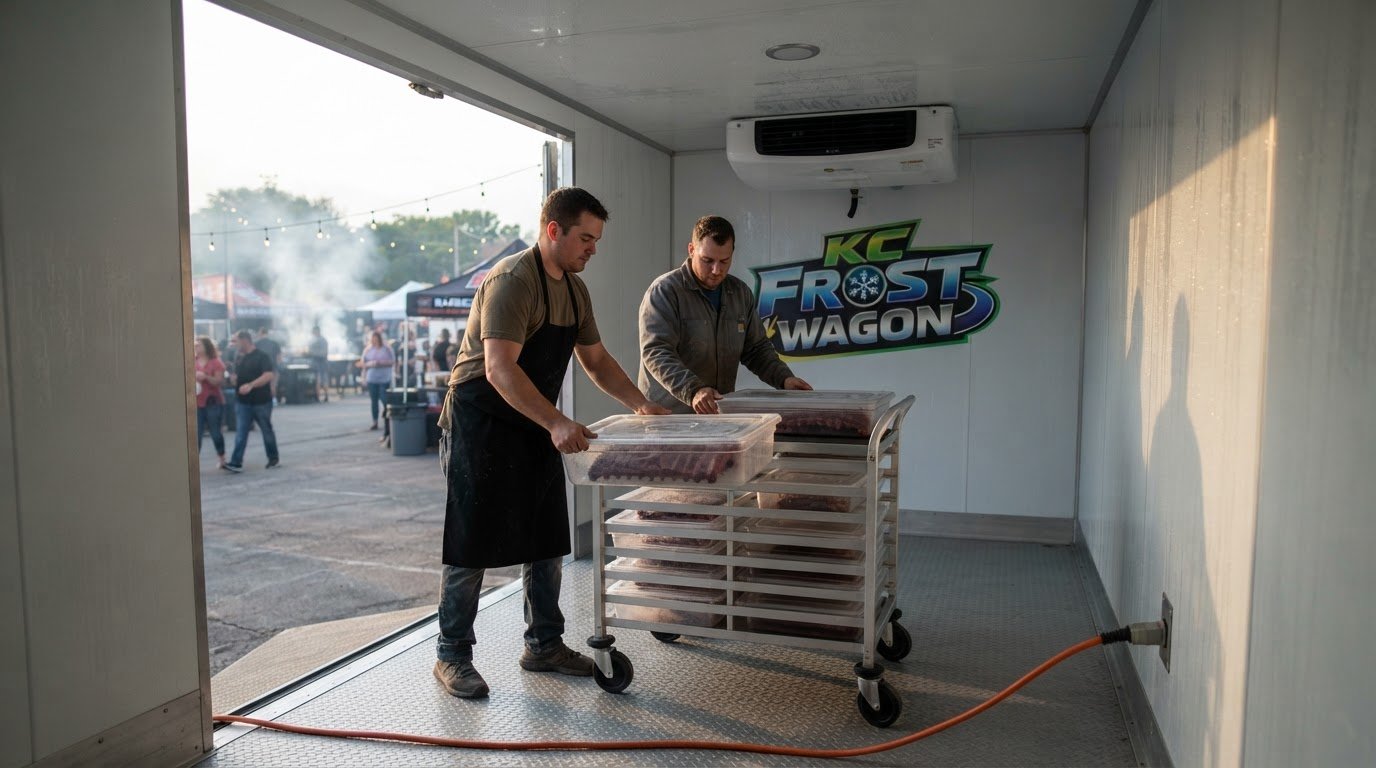
What can put competition meat at risk faster than a busy festival schedule? A ribfest competition meat cooler needs a suitable temperature, organized storage, and a plan for weather or power disruptions. The right setup helps protect meat as cooking and service plans move forward.
It’s easy to focus on cooler capacity and overlook how often it will be opened, how the meat will be arranged, and where the cooler will sit. Those details matter at a Kansas City Ribfest, where heat, storms, and event logistics can affect cold storage.
This guide explains how temperature and meat storage fit into a competition plan, what to consider when renting a cooler, and how to prepare for changing weather. It also covers how refrigerated trailer rental can support event cold storage in the Kansas City metro, including Overland Park, Olathe, Lenexa, Shawnee, Leawood, Lee’s Summit, Independence, Blue Springs, Liberty, and Prairie Village.
Key Takeaways
- Plan where cold storage will sit and how the team will protect it if weather or power conditions change.
- Organize meat storage around the cooking and judging schedule to make access smoother during a busy competition.
- Use temperature guidance to shape your storage plan and understand how time outside controlled refrigeration affects food handling.
- Choose cooler capacity based on the amount of competition meat and the space needed for organized storage.
- For Kansas City metro event cold storage, contact KC Frost Wagon at (913) 421-3778 to discuss a trailer rental quote.
Weather and event-contingency policy
For a Kansas City Rib Fest, start with the host’s written policy. It explains who announces delays, judging changes, or cancellation. Map how each decision affects meat delivery, cooking, storage, and team access. A storm plan should identify a sheltered storage location, a clear route to the cooking area, and the person responsible for receiving organizer updates. This gives the team a defined response if conditions change during setup or service.
Before competition day, assign weather-related responsibilities. One team member can monitor organizer messages while another protects covered food and keeps supplies organized. Identify where equipment and supplies can be moved if rain or wind reaches the cooking station. Keep access paths clear and avoid placing items where runoff could collect. In Kansas City, Overland Park, Olathe, Lenexa, Shawnee, Leawood, Lee’s Summit, Independence, Blue Springs, Liberty, and Prairie Village, venue layouts and event instructions shape a practical contingency plan.
Separate the host’s decisions from the team’s preparations. Organizers decide whether a competition pauses, relocates, or continues. Don’t assume a weather delay automatically changes turn-in times. Record the event contact method, meeting point, and procedure for protecting stored meat during a pause. If organizers stop cooking, for example, the team can secure its supplies and wait for an official schedule update before changing its work sequence.
Build the plan around every stage of the event, not just judging. A Kansas City festival may involve setup, cooking, judging, and service, each with different storage and access needs. Plan the sequence for receiving meat, storing it, moving it to the cooking station, and meeting the host’s deadlines. If the schedule changes, the team lead can identify which steps shift and tell each person what to do next.
Read the host’s instructions about equipment placement and access before arrival. A venue may set specific requirements for unloading, working, or storing supplies. Keep the storage area accessible to the team while respecting event boundaries and inspection procedures. Rules vary by event, so don’t assume a policy from another festival applies. Keep a copy of the local host’s instructions handy to prevent confusion during setup.
Weather contingencies still matter when the contest continues. Wet ground, wind direction, or a crowded cooking area can make moving meat and equipment harder. Keep the route between storage and the cooking station clear, and group supplies so the team can move them efficiently. If your setup includes a generator, follow venue instructions for its placement. The aim is to adapt without rushing food or equipment along an obstructed route.
Competition records need context. A winning weight or event record belongs to its specific contest format; an eating-contest result isn’t a benchmark for barbecue judging. Use the local contest’s judging criteria and published schedule to guide preparation. Before event day, distinguish judging portions from food intended for service, then assign someone to track schedule updates that affect those portions.
For a Kansas City-area Rib Fest, use a simple contingency sequence: review the host’s policy, identify the update contact, protect stored meat, and wait for official instructions before resuming work. Keep team responsibilities clear if a delay overlaps with preparation or judging. Local venue rules govern access and weather response. A clear plan helps teams adjust their workflow while keeping competition meat handling organized.
For comparison, event-specific details can anchor a contingency checklist without replacing the host’s instructions. James Webb ate 9.65 pounds of ribs in 12 minutes, setting a new event record. The Great Midwest Rib Fest page gives the world record for eating pork meat as 13.76 pounds in 12 minutes; the world record cited for the Great Midwest Rib Fest eating championship is 13.76 pounds in 12 minutes.
The 2026 Great Midwest Rib Fest rib-eating contest is scheduled to start at 4:00 PM CT. Its contest venue is the Dolan Lot at Mystic Lake Casino Hotel, 2400 Mystic Lake Blvd NW, Prior Lake, Minnesota 55372. These details illustrate why a team should verify the specific schedule, location, access route, and organizer updates for its own contest, then keep its plan aligned with official instructions. A listed start time or venue does not specify what happens if weather disrupts an event, so confirm any pause, relocation, or cancellation procedure directly with the host before deciding how the team will respond.
Cooler temperature and storage requirements
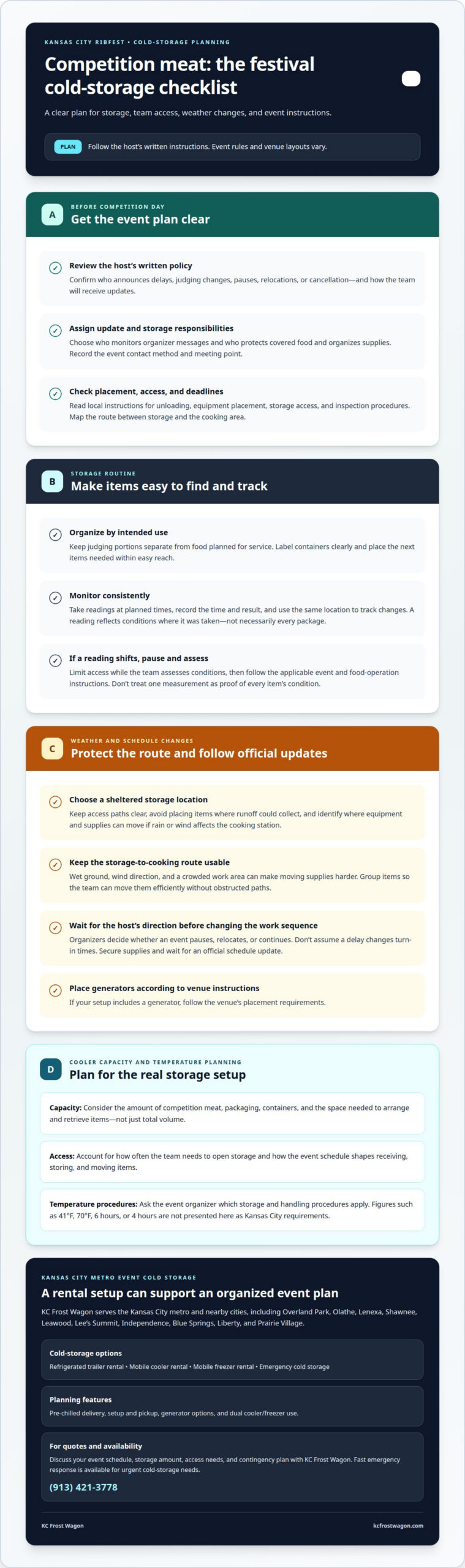
For a Kansas City competition, plan storage around the meat’s condition when it arrives, how often the team needs access, and the event schedule. Don’t assume figures such as 41°F, 70°F, 6 hours, or 4 hours are Kansas City requirements. Ask the event organizer which storage and handling procedures apply, and follow the instructions for your food operation.
Arrange competition meat so team members can find each item without searching through other packages. Separate items by intended use, such as ribs for judging and meat planned for service. Label containers clearly and keep the next items needed within easy reach. This reduces unnecessary handling during a busy cooking period. A simple layout also helps team members return items to the right place after retrieving them.
Use a consistent temperature-monitoring routine. Take readings at planned times, record the time and result, and note unusual changes. A reading describes conditions at the point where it was taken, so use the same location when tracking changes. If a reading shifts, limit access while the team assesses conditions and follows applicable event instructions. Don’t treat one measurement as proof that every package has the same temperature.
Storage capacity depends on more than the total amount of meat. Packaging, containers, and the space needed to arrange and retrieve items all affect the layout. Tightly stacking packages, for example, can hide labels and make it harder to remove one item without disturbing others. Plan the arrangement before loading. Keep raw items separate from cooked or ready-to-serve food, and protect containers from crushing or unnecessary movement.
Ask the Kansas City event organizer for the applicable storage and handling procedures. Requirements can differ between festivals, so don’t treat a rule from another event or state as local policy. Organizers may also have venue-specific instructions for equipment placement, access, or inspection. Keep those directions with the team’s event plan so the person handling meat can refer to them during setup and competition.
Plan storage around the actual judging timetable. If ribs and other meats have different preparation or turn-in times, identify each category in advance and keep judging portions easy to find. Use the event’s current schedule to decide when items need to move from storage to preparation. This sequence helps prevent last-minute searching and keeps judging portions separate from food intended for service.
Power interruptions need a clear response. Assign someone to notice a power loss, keep cooler doors closed, and inform the team lead. Record when it occurred and any temperature readings, then follow the event’s handling directions. If a generator is part of the setup, place and operate it according to venue instructions. Don’t move food to another storage area without a plan to keep it protected and accounted for.
For Kansas City, Overland Park, Olathe, and Lee’s Summit competitions, prepare a written storage sequence: receive, label, arrange, monitor, and retrieve. Event cold storage can help keep competition meat organized near the work area. A team planning temporary storage can discuss an event cold-storage plan suited to its schedule and layout.
Before competition, identify who will monitor the cooler and who will track when goods are taken out. Agree on a clear way to communicate those times, so a handoff between team members does not leave anyone guessing. If the schedule changes or access is delayed, reassess the plan promptly and ask the organizer for direction. Keep the team’s notes together with its event instructions, and make sure the person responsible for food handling can consult them during setup. These steps help the team coordinate its handling practices with the event’s stated procedures. Follow any additional instructions provided for the competition, and do not assume that one event’s procedures automatically apply elsewhere.
KC Frost Wagon
KC Frost Wagon helps Kansas City competition teams plan event cold storage around their schedule and site layout. Refrigerated trailers arrive pre-chilled, with delivery, setup, and pickup arranged for the event. The 12×6 and 16×6 trailers are available with or without a generator and can also plug into a dedicated 120 V outlet. Ask about a setup supporting both cooler and freezer storage for teams with different needs. Fast emergency refrigeration response is available when a breakdown disrupts a team’s cold-storage plan.
For a Kansas City, Overland Park, Olathe, or Lee’s Summit event, share the location, dates, and storage needs to discuss a rental plan. Contact KC Frost Wagon at (913) 421-3778 to talk through your competition’s cold-storage needs.
Plan your next competition with confidence
Make cold storage part of the competition plan, not a last-minute adjustment. Add storage arrangements to the event run sheet alongside cooking assignments, judging deadlines, and weather updates. This gives the team a shared reference when schedules or responsibilities change. A ribfest competition meat cooler works best as part of a coordinated workflow, with clear access and handling roles.
For a Kansas City-area event, consider the venue layout, expected meat volume, and the team’s movement between storage and cooking areas. Sharing those details early can help shape a practical rental plan for your event. KC Frost Wagon serves the Kansas City metro and nearby cities, including Overland Park, Olathe, and Lee’s Summit.
Ready to plan cold storage for your competition? Contact KC Frost Wagon about cooler rental to discuss your event needs. A clear plan lets your team focus on the cook and enjoy competition day.
Frequently Asked Questions
What type and size of cooler do ribfest teams use to store competition meat?
Teams use refrigerated storage that fits their food load and festival setup; there’s no single standard for every contest. A mobile cooler or refrigerated trailer can provide temporary capacity when a team needs more than its existing equipment holds. Choose based on the amount and shape of the packaged meat, the available site space, and how the event permits equipment to be placed. Follow the host’s specific rules.
How should competition ribs and other meats be transported and kept cold?
Plan the route and arrival timing so competition meat spends as little time as practical in transit and transfer. Keep packages secure during the trip, and avoid combining meat with non-food equipment or supplies. At the venue, follow the host’s instructions for receiving and storing food. If travel is delayed or refrigeration is interrupted, tell the team lead promptly and follow the event’s food-handling procedure.
What cooler capacity is suitable for a ribfest competition team?
Estimate capacity from the total packaged volume, not just the number of competitors. Include every category the team plans to store, plus containers and the room needed to access them. Then compare that load with the storage space available at the venue. If teams share facilities, account for the space allocated to your group. A clear inventory before the event helps avoid choosing a unit that cannot accommodate the planned load.
What food-safety risks should teams watch for when storing meat at a ribfest?
Watch for temperature changes, damaged packaging, contamination from shared surfaces, and delays that leave food outside controlled refrigeration. Keep food away from chemicals and personal belongings, and use clean preparation surfaces and utensils. Rain or a power interruption can also disrupt storage, so know the event’s response procedure. If food’s condition becomes questionable, separate it and follow the organizer’s handling instructions rather than serving it.

