
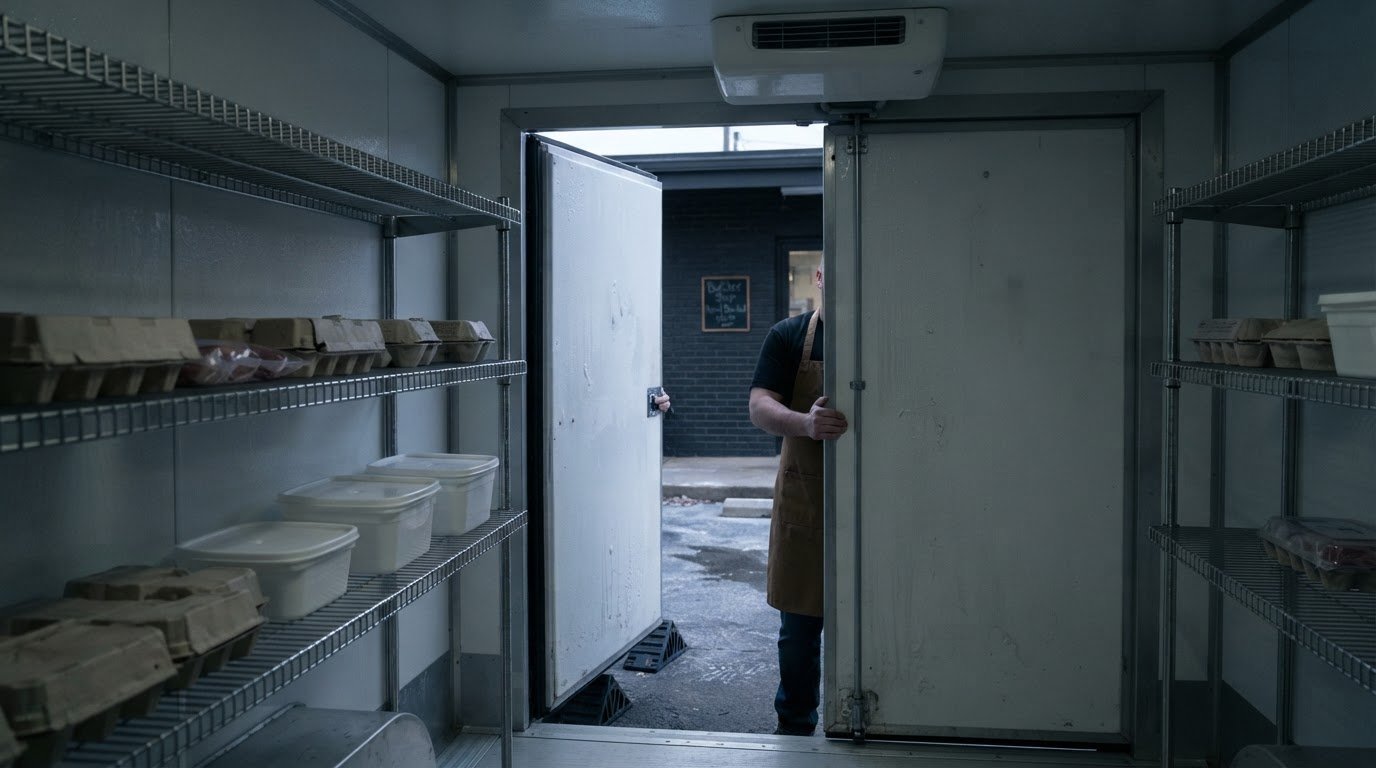
A closed freezer buys time, but it doesn’t make an outage harmless. According to the United States Department of Agriculture, a full freezer can usually maintain a safe temperature for about 48 hours if its door stays closed; a half-full freezer may do so for about 24 hours. For a butcher shop, a backup freezer for butcher shop operations should be part of a wider plan for protecting product and keeping cold storage running.
It’s natural to focus on freezer capacity first. But placement, power needs, door access, and a clear outage plan also affect how well you can protect stored meat when equipment fails or power is interrupted.
This guide explains how to size and position backup cold storage, plan for power needs, and respond during an outage. Butcher shops in the Kansas City area can use these practical steps to prepare for disruptions and keep cold-chain operations organized.
Key Takeaways
- Match backup storage capacity to the volume and type of meat your shop needs to protect.
- Plan freezer placement and organization to support airflow, access, and steady storage conditions.
- Include power needs and outage procedures in your cold-chain plan, not just freezer capacity.
- Choose between walk-in, reach-in, chest, or trailer storage based on your space, access, and backup needs.
- For temporary commercial backup refrigeration in the Kansas City metro and nearby cities, KC Frost Wagon rents 12×6 and 16×6 cooler/freezer refrigerated trailers.
Maintaining temperatures during power outages
During an outage, keep freezer doors closed and track temperatures rather than relying on appearance. A documented response helps Kansas City butcher shops make informed decisions about stored meat.
Outage Temperature Retention
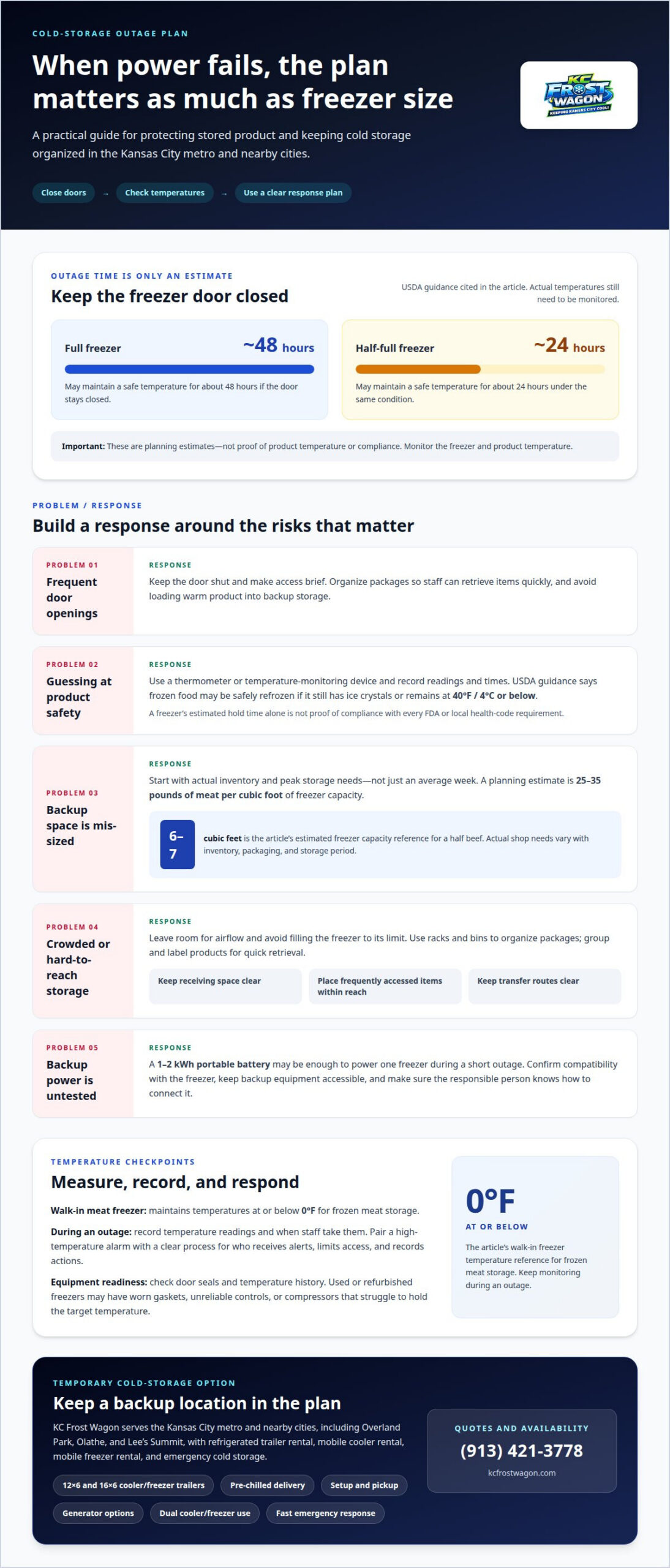
A full freezer can usually maintain a safe temperature for about 48 hours if its door stays closed, according to the United States Department of Agriculture. A half-full freezer may maintain a safe temperature for about 24 hours under the same condition, according to the United States Department of Agriculture. These are planning estimates, not a substitute for monitoring the actual freezer and product temperature.
For frozen meat storage, a walk-in meat freezer maintains temperatures at or below 0°F. Insulation, door seals, room conditions, and how often staff open the door all affect temperature retention. During an outage, keep access brief and limit door openings. A chest freezer can also retain cold well, but its actual temperature still needs monitoring.
Applicable Food Safety Requirements
For outage decisions, the United States Department of Agriculture says frozen food may be safely refrozen if it still has ice crystals or remains at 40°F / 4°C or below. This temperature guidance does not establish every FDA or local health-code requirement for a butcher shop. A freezer’s estimated hold time alone should not be treated as proof of compliance.
Use a thermometer or temperature-monitoring device to record readings during an outage, and note when staff take them. A high-temperature alarm can prompt a faster response. Set a clear process for who receives alerts, who limits door access, and who records readings. This record helps the shop assess each affected storage area.
Warm, moist air entering through an open door can affect temperature and humidity. Keep the door shut, avoid loading warm product into backup storage, and organize packages so staff can retrieve them quickly. Stable conditions help protect meat quality, but the freezer’s temperature reading remains the key measurement during an outage.
Used or refurbished freezers can have worn gaskets, unreliable controls, or compressors that struggle to hold the target temperature. Before relying on one in a backup plan, run it under normal operating conditions and review its temperature history. Check warranty terms for coverage of parts, labor, the compressor, controls, and exclusions.
A backup plan can also account for power needs before an outage begins. A 1-2 kWh portable battery may be enough to power one freezer during a short outage. Confirm that the battery and freezer are compatible and that the backup equipment is ready to use. Keep it accessible, and make sure the person responsible knows how to connect it. This can help maintain cold storage while the shop evaluates the outage and decides on next steps.
An alarm can notify the owner when freezer temperature rises, so someone able to respond receives the warning. Pair the alert with a clear way to check the reading and record any action taken. Insulation can help maintain consistent temperatures and reduce strain on refrigeration equipment. It does not replace temperature checks during an outage, but it can support a broader plan that includes closed doors, monitoring, and backup power. Review these measures together so the shop can respond promptly when normal power is interrupted.
Storage size, layout, and placement
Size backup capacity around the amount and type of meat your Kansas City shop must hold during a disruption. A planning estimate is 25-35 pounds of meat per cubic foot of freezer capacity. Use your actual inventory and peak storage needs, not just the average week. Separate the estimate by product type and package size, then allow space for staff to move and retrieve items properly.
A half beef provides one useful reference point: its estimated freezer capacity is 6-7 cubic feet. Your shop’s needs will differ with its inventory, packaging, and storage period. Choose capacity close to anticipated demand. Avoid leaving excessive empty space in the freezer, as it can make storage less efficient. Revisit the estimate when seasonal demand or ordering patterns change.
Plan the interior as carefully as the storage capacity. Leave room for air to circulate around packages, and avoid filling the freezer to its limit. Dunnage racks and bins can keep products organized, support airflow, and make access easier. Group packages by product and label them clearly so staff can find the right item without searching through stacks.
- Keep a receiving area clear so incoming packages don’t block stored products.
- Place frequently accessed items where staff can reach them without moving other stock.
- Separate product groups with bins or dedicated rack areas to support orderly handling.
Door style also affects layout. Solid doors prioritize insulation in back-of-house storage, while glass doors suit display and retail counter use. For backup capacity, consider how the door fits the shop’s workflow: one facing a busy work area may be opened more often, while a less-trafficked location can make access easier to control. Keep the route to the freezer clear for routine use and emergency transfers.
Choose a location that supports access, stable operation, and routine cleaning. Keep the unit away from avoidable heat sources, and leave its operating area unobstructed. Before an outage, decide where staff will stage packages and how they’ll move them into backup storage. For wedding and catering operations, a planned layout can also keep event inventory organized during busy service periods.
Need to plan temporary cold-storage space for a Kansas City operation? Discuss your cold-storage needs before a disruption or busy service period.
Cold-chain applications
A butcher shop’s cold chain connects receiving, storage, preparation, and dispatch. Each transfer creates a chance for temperature changes or cross-contamination, so plan how product moves between stations. A commercial freezer supports longer-term frozen storage, while a meat-hanging cooler is designed to keep meat products between 28°F and 35°F. Keep these roles distinct in the shop’s workflow.
For frozen inventory, stable temperatures and sealed packaging help limit freezer burn on bulk meat. Pack each product in airtight containers or freezer bags, then label it clearly before storage. Proper sealing also helps prevent cross-contamination when different types of meat share a freezer. Organize items by product group and keep packages contained rather than loose against other products.
Use a first-in, first-out rotation system to keep older stock moving. Place newer packages behind or below older ones so staff can reach earlier inventory first. Labels should identify the product and the receiving or packing date used by the shop. For example, a clearly marked bin for each product group makes it easier to find the right item without disturbing other packages.
Air circulation matters inside a commercial freezer. Evaporator fans circulate sub-zero air around dense proteins, helping reduce their core temperature quickly. Avoid packing product tightly against vents or blocking fan movement with cartons. Dunnage racks and bins can separate packages from the floor and improve access, while a simple layout helps staff return products to their assigned locations.
Plan each cold-chain handoff before moving inventory. During receiving, keep packages together by type and move them promptly to their assigned storage area. During preparation, return unused sealed product to suitable cold storage instead of leaving it on a work surface. At dispatch, group orders by destination and keep frozen and chilled items in their appropriate temperature zones.
Cleaning and storage surfaces also shape day-to-day handling. Food-safety surfaces in meat-processing cold storage use materials suited to that purpose. Stainless steel or specialized epoxy liners in commercial meat freezers can resist acids and routine sanitation. Choose cleaning steps suited to the equipment’s interior finish, and inspect gaskets during routine cleaning. Airtight magnetic gaskets help keep humidity out and support consistent storage conditions.
For Kansas City shops handling both frozen stock and fresh hanging products, map the movement between the 0°F-or-below freezer and the 28°F-to-35°F cooler. Clear labels, sealed packages, organized bins, and unobstructed airflow turn that plan into repeatable staff practice.
Energy efficiency and power outages
Size electrical service and backup power using the freezer’s nameplate, including its running load and compressor startup surge. Include any refrigerator and other equipment expected to run at the same time, then have a qualified electrician assess the shop’s electrical setup.
A freezer may draw around 180 watts while running, with startup surge reaching about 1,800 watts. That difference matters: backup equipment must handle the brief starting demand as well as ongoing operation. Treat these figures as planning examples, not specifications for every commercial unit. Use the actual freezer nameplate and manufacturer information to estimate its load.
Energy use also varies by freezer type. A standard chest freezer uses about 215 kWh per year, while a standard upright freezer uses about 395 kWh per year. These figures help compare energy patterns, but a butcher shop’s commercial equipment may differ. Compare the unit’s stated consumption and operating needs before deciding how much backup capacity to plan.
For a battery system, account for inverter losses and a reserve so the freezer doesn’t drain the available capacity completely. A planning range of 85-90% inverter efficiency and a 20-30% safety margin can help frame the calculation. One standard freezer may call for 1,000Wh-2,000Wh of battery capacity for overnight or short blackout support. Actual runtime depends on the freezer’s load and how often its compressor runs.
For a shop with multiple units, add the loads rather than sizing around one freezer. A plan for multiple freezers may require 5kWh or more, depending on equipment use and the outage period. A battery sized for one freezer won’t automatically cover a second freezer, a refrigerator, and other connected equipment. List the equipment that must stay powered, then calculate its combined demand.
- Record each unit’s nameplate load and startup information.
- Identify which freezer or refrigerator is the priority during an outage.
- Include simultaneous equipment and inverter losses in the backup-capacity plan.
- Keep a temperature-monitoring device active so staff can track storage conditions.
A generator plan also depends on startup demand and the other equipment running at the same time. Confirm that the generator’s output can support those loads, and plan how power will reach the freezer. In Kansas City, a butcher shop can make its outage plan more useful by assigning staff to monitor temperatures and record changes, rather than relying on runtime estimates alone.
Prepare for stable operation before an outage: maintain the freezer, document its normal power use, and know which loads backup power supports. These steps make capacity decisions practical rather than guesswork.
Best commercial backup freezers for butcher shops
The right backup depends on what must stay frozen, how staff access it, and how long extra capacity is needed. A walk-in, reach-in, chest freezer, or refrigerated trailer can serve a different role. Compare usable storage, access patterns, placement, and power planning before choosing backup for a Kansas City shop.
Walk-in freezer: A walk-in suits shops moving larger quantities or handling frequent inventory transfers. Staff can organize bulk cuts and meat lugs across the interior, but the footprint and access route need careful planning. Consider whether the shop needs a permanent second storage area or temporary backup during equipment trouble. A walk-in is most useful when its space and operation match regular inventory needs.
Reach-in freezer: Reach-ins provide quick access and a high-hygiene exterior, making them practical near work areas where staff retrieve smaller batches throughout a shift. They can support backup storage for selected products, but the layout should prevent frequent door openings from disrupting routine work. Choose this style when fast access matters more than storing large, less frequently handled batches.
Chest freezer: Chest freezers suit long-term bulk storage of primal cuts and can retain cold effectively. Their top-opening design can make frequent retrieval less convenient, especially when packages are stacked deeply. Use bins or a clear product arrangement so staff can locate stock without shifting unrelated packages. A chest model can serve as a focused reserve for sealed products that don’t need constant access.
Refrigerated trailer: A trailer can provide temporary backup storage when the shop needs space beyond its fixed freezer capacity. It may also be useful during a repair or a short-term increase in inventory. Plan where it will sit and how staff will move packaged product between the shop and the unit. A trailer is a different choice from buying another fixed freezer: it offers a temporary storage option rather than permanent back-room equipment.
Use this quick comparison to narrow the decision:
- Choose a walk-in when bulk volume and regular access drive the need.
- Consider a reach-in when staff need frequent access to smaller quantities.
- Use a chest freezer for organized, longer-term bulk storage.
- Consider a refrigerated trailer when the requirement is temporary or additional capacity is needed.
Before selecting a unit, map the inventory it will hold, the staff route to it, and its electrical needs. A backup unit should support the shop’s operation without blocking deliveries or daily work. For temporary capacity during a disruption or busy period, discuss refrigerated trailer options for your storage needs.
KC Frost Wagon: Commercial backup refrigeration
KC Frost Wagon provides commercial backup refrigeration for butcher shops facing equipment breakdowns or power outages. Its 12×6 and 16×6 cooler/freezer refrigerated trailers arrive pre-chilled, with delivery, setup, and pickup serving the Kansas City metro and nearby cities.
Choose cooler or freezer storage to suit the products you need to protect. Each trailer is available with or without a generator and can plug into a dedicated 120V outlet. For urgent cold-storage needs, KC Frost Wagon provides fast emergency response.
Call (913) 421-3778 or contact KC Frost Wagon for a quote and to check availability for freezer backup for your shop.
Build your outage plan before the next disruption
A backup freezer for a butcher shop works best as part of a clear continuity plan, not as an isolated equipment decision. Decide who coordinates product transfers, which inventory takes priority, and how staff communicate during an interruption. A simple written plan gives each shift a practical starting point, even when the usual storage setup changes unexpectedly.
Make the next step a short planning conversation. Identify the storage gap you need to cover, where temporary cold storage could fit, and what your team needs to keep service moving. For Kansas City businesses, KC Frost Wagon offers refrigerated trailer rental for commercial backup refrigeration. A focused discussion can help connect your shop’s needs with an appropriate cold-storage option.
Contact KC Frost Wagon for a quote and to check availability, and take the next step toward a more prepared operation.
Frequently Asked Questions
How Long Can a Freezer Stay Cold Without Power?
A full freezer can usually hold a safe temperature for about 48 hours with its door closed; a half-full freezer may do so for about 24 hours, according to the United States Department of Agriculture. During an outage, avoid opening the door and monitor temperatures. The USDA says frozen food may be safely refrozen if it still has ice crystals or remains at 40°F / 4°C or below.
What size backup freezer does a butcher shop need based on inventory and daily throughput?
Size backup capacity for the inventory that must be protected during a disruption, not simply the shop’s total sales. Review the quantity on hand during busy periods, how quickly products move, and whether incoming stock needs space. For a backup freezer for a butcher shop, separate the planned reserve by product group, then leave practical room for organized loading and retrieval without blocking airflow.
What are the energy use and operating costs of commercial backup freezers?
Energy use depends on the freezer’s model, operating condition, door access, and compressor use. To estimate electricity expense, use the unit’s energy-consumption information and your electricity rate, then account for how long it operates. Rental pricing is separate from appliance electricity estimates. Compare capacity and power requirements alongside operating expense.
How can a butcher shop plan freezer capacity and procedures during a primary freezer failure or power outage?
Prepare a written response plan that identifies priority inventory, who coordinates transfers, and where staff will place products. Keep a current stock list and make transfer routes clear. If fixed capacity is insufficient, a refrigerated trailer rental can provide additional commercial cold storage. KC Frost Wagon serves Kansas City, Overland Park, Olathe, Lenexa, Shawnee, Leawood, Lee’s Summit, Independence, Blue Springs, Liberty, and Prairie Village, within the Kansas City metro area.

