
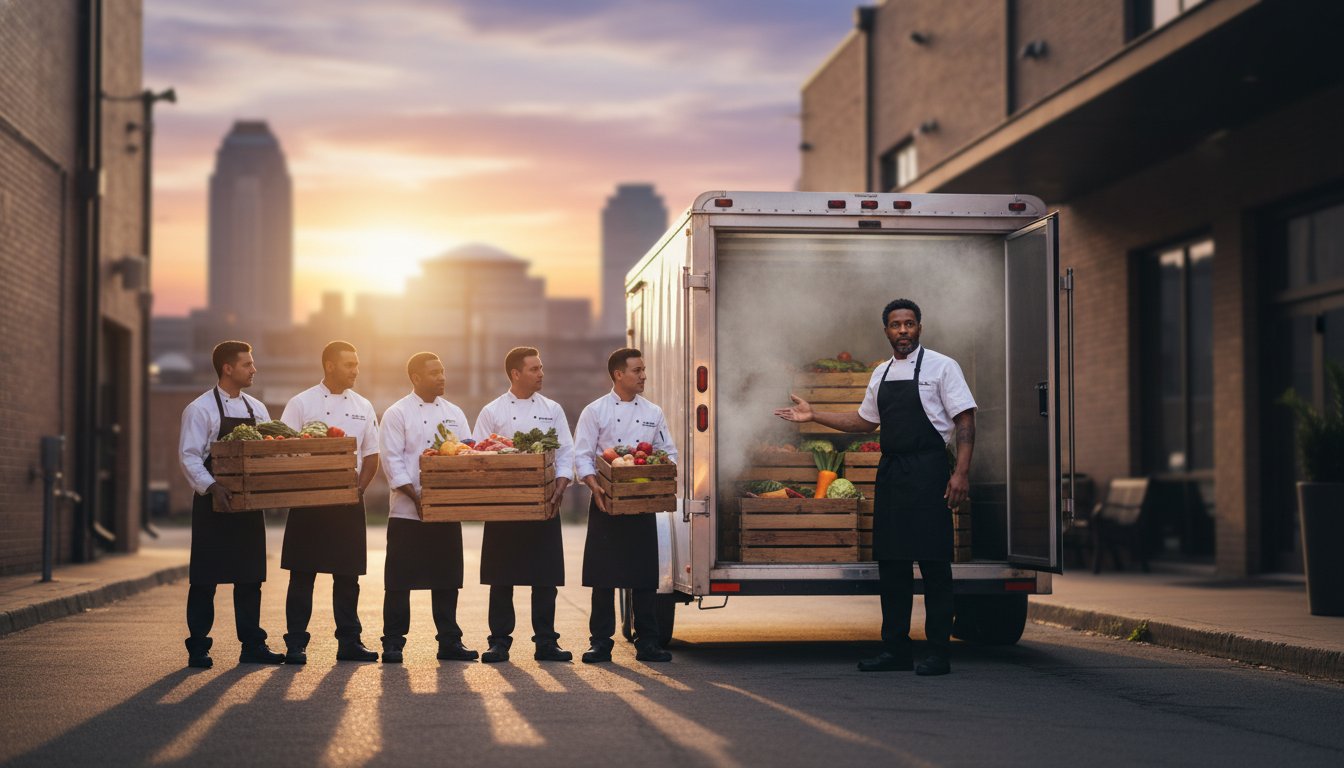
The restaurant industry loses an estimated $162 billion annually to food waste. Much of that loss happens in a single afternoon when a compressor dies or the power cuts out. When your walk-in fails, you aren’t just losing ingredients; you’re losing your profit margin for the entire month. You need a restaurant emergency plan refrigeration strategy that moves faster than your inventory can thaw. It’s a race against thermal decay, and right now, the clock is ticking.
We understand the gut-punch feeling of watching temperature gauges climb while your kitchen staff scrambles. It’s incredibly stressful to manage a crisis when you lack immediate backup cooling options. This guide provides the definitive roadmap to protecting your business continuity and achieving zero food waste during a breakdown. We’ll walk through a clear, actionable response plan, explain the critical 2026 refrigerant regulations you must follow, and show you how to secure reliable mobile backup cooling before your inventory is ruined.
Key Takeaways
- Learn why a dedicated response plan is a survival blueprint, not just a repair call.
- Master the four pillars of a restaurant emergency plan refrigeration strategy to stop inventory loss before it starts.
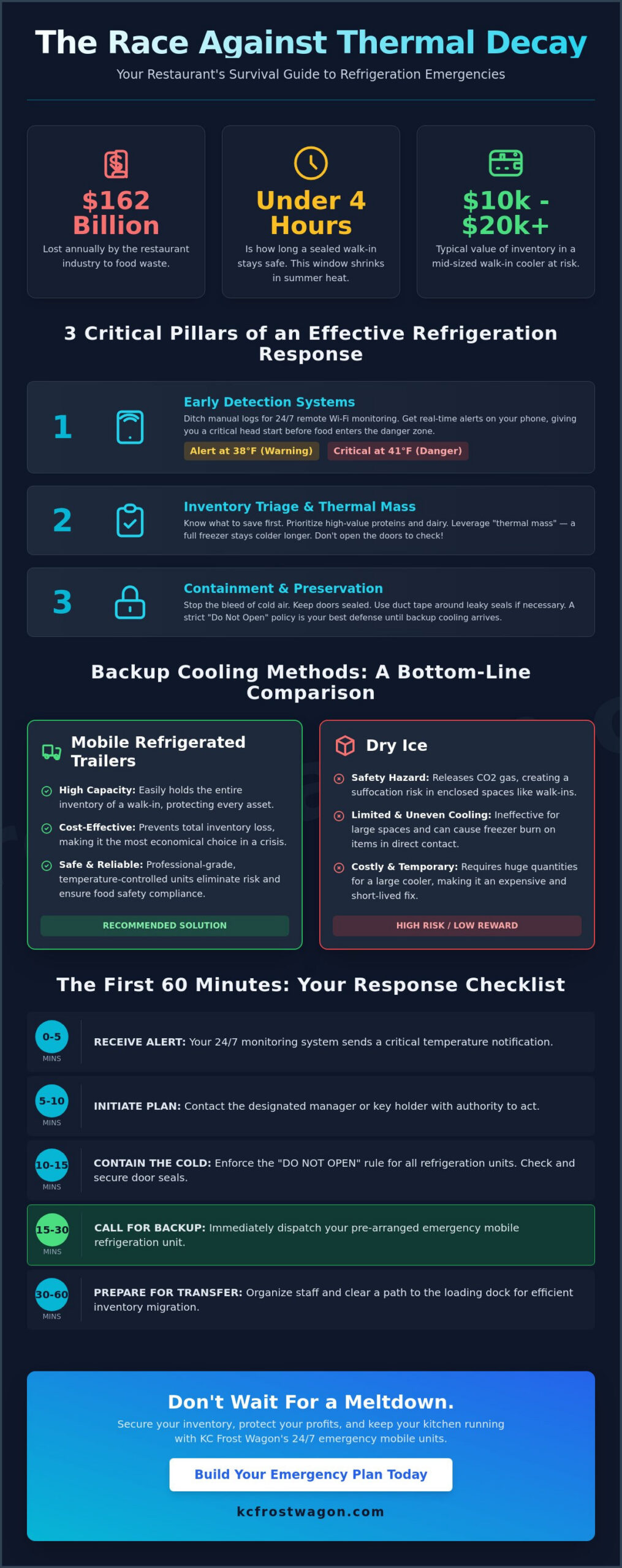
- Compare backup cooling methods to see why mobile trailers beat dry ice for safety and cost.
- Follow a 60-minute response checklist to manage your team and contain temperatures during a sudden breakdown.
- Discover how 24/7 emergency mobile units provide immediate relief and keep your kitchen running.
Why Your Restaurant Needs a Dedicated Refrigeration Emergency Plan
A refrigeration emergency plan is more than a phone number for a repairman. It’s a logistical blueprint for inventory survival. When the compressor fails, you are in a race against the clock. Without a strategy, you’re just reacting. Reaction leads to chaos. Chaos leads to waste. A solid restaurant emergency plan refrigeration strategy ensures your team knows exactly what to do the moment the temperature rises. It moves your business from a state of panic to a state of professional response.
The “Thermal Clock” is your biggest enemy. Most commercial walk-ins can maintain safe temperatures for about four hours if the doors remain sealed. However, local Kansas City conditions change the math. Our intense summer heat and high humidity levels force your equipment to work harder. Once that equipment stops, the ambient heat penetrates the insulation faster than you’d expect. Every minute you spend wondering what to do is a minute closer to total inventory loss. This isn’t just about the food you throw away. It’s about the lost revenue from a closed kitchen, the labor costs of a massive cleanup, and the long-term damage to your brand’s reputation.
The Financial Impact of Cooling Failure
Think about the value sitting in your cooler right now. A fully stocked walk-in for a mid-sized restaurant often contains between $10,000 and $20,000 of product. For high-end establishments, that number can easily double. “Waiting and seeing” if the power comes back on is the most expensive gamble you can take. In 2026, supply chain costs remain volatile. Replacing specialized ingredients or high-grade proteins isn’t just expensive; it can be nearly impossible on short notice. Protecting your existing cold chain is the only way to safeguard your bottom line and keep your doors open.
Regulatory and Health Code Implications
Health inspectors don’t care about your excuses. They care about the HACCP requirements for temperature monitoring and food safety. Serving food that has sat in “borderline” temperatures is a massive legal risk. It only takes one sick customer to destroy a brand you spent years building. Having a documented restaurant emergency plan refrigeration protocol shows inspectors you’re proactive. It proves you have control over your environment even when the equipment fails. When you can show a clear log of how you moved inventory to a mobile backup unit, you turn a potential health violation into a success story of professional management.
The 4 Critical Pillars of an Effective Refrigeration Response
A crisis doesn’t wait for your doors to open. It often hits at 3:00 AM when the kitchen is dark and the building is empty. To survive a breakdown without losing your shirt, your restaurant emergency plan refrigeration strategy must rest on four distinct pillars. These aren’t just suggestions; they’re your line of defense against thousands of dollars in spoiled inventory. Moving from a state of panic to a state of professional response requires a shift in how you view your cold storage.
Pillar 1: Early Detection Systems
Manual temperature logs are a relic of the past. If you’re still relying on a staff member to check a dial every four hours, you’re already behind the curve. Modern 24/7 remote monitoring systems use Wi-Fi sensors to beam real-time data directly to your phone. You should set your “Warning” threshold at 38°F and your “Critical” alert at 41°F. This gives you a vital buffer before food hits the danger zone. Establish a clear chain of command for after-hours alerts so the first person notified has the authority to call for a mobile cooler rental Kansas City immediately.
Pillar 2: Inventory Triage and Thermal Mass
Not all inventory is created equal. When the cooling stops, you need to identify high-value assets versus highly perishable items. This is where you leverage “thermal mass.” A packed freezer acts like a giant ice block; it stays cold much longer than a half-empty unit. Don’t open the doors to “check” things. Every time you crack the seal, you lose precious cold air. Focus your rescue efforts on proteins and dairy first. Consult the official guidelines for emergency preparedness for power outages to know exactly which items are salvageable and which must be discarded if temperatures climb.
Pillar 3: Containment and Thermal Preservation
Containment is about slowing the bleed of cold air. If a repair is hours away, you must seal the unit and keep it shut. Use duct tape around door seals if you suspect a leak. If you have a backup unit on the way, keep the walk-in closed until the trailer is backed up to your loading dock. Every action should be calculated to keep the cold in. This “Do Not Open” protocol is the most important instruction you can give your staff during the first hour of a failure.
Pillar 4: Relocation Logistics
The final pillar is the physical move. You need a designated team and a clear path to your temporary storage. Don’t wait for the floor to be covered in meltwater to start moving. If a technician confirms that parts are six hours away, pull the trigger on relocation immediately. Ensure your team has heavy-duty carts and insulated gloves ready to execute the move safely. A fast, organized transition to a mobile unit is the only way to guarantee zero food waste during a long-term equipment failure.
Comparing Backup Cooling Methods: Which One Saves Your Bottom Line?
Most online advice focuses on when to throw your inventory away. That is a defeatist attitude. A proactive restaurant emergency plan refrigeration strategy focuses on how to keep that inventory cold while your main system is down. You have several options to choose from, but not all of them are practical for a busy kitchen in the middle of a lunch rush. You need a solution that balances speed, safety, and logistical ease.
Why Mobile Trailers Outperform Reefer Trucks
Reefer trucks are the giants of the cold chain, but they are often a nightmare for local restaurants. These massive vehicles require dock-height loading bays. If your restaurant doesn’t have a loading dock, your staff will be lifting heavy crates four feet into the air. That is a recipe for back injuries and broken glass. Mobile trailers sit at ground level. You can wheel a cart directly from your walk-in into the trailer without skipping a beat. This saves your labor costs and protects your team.
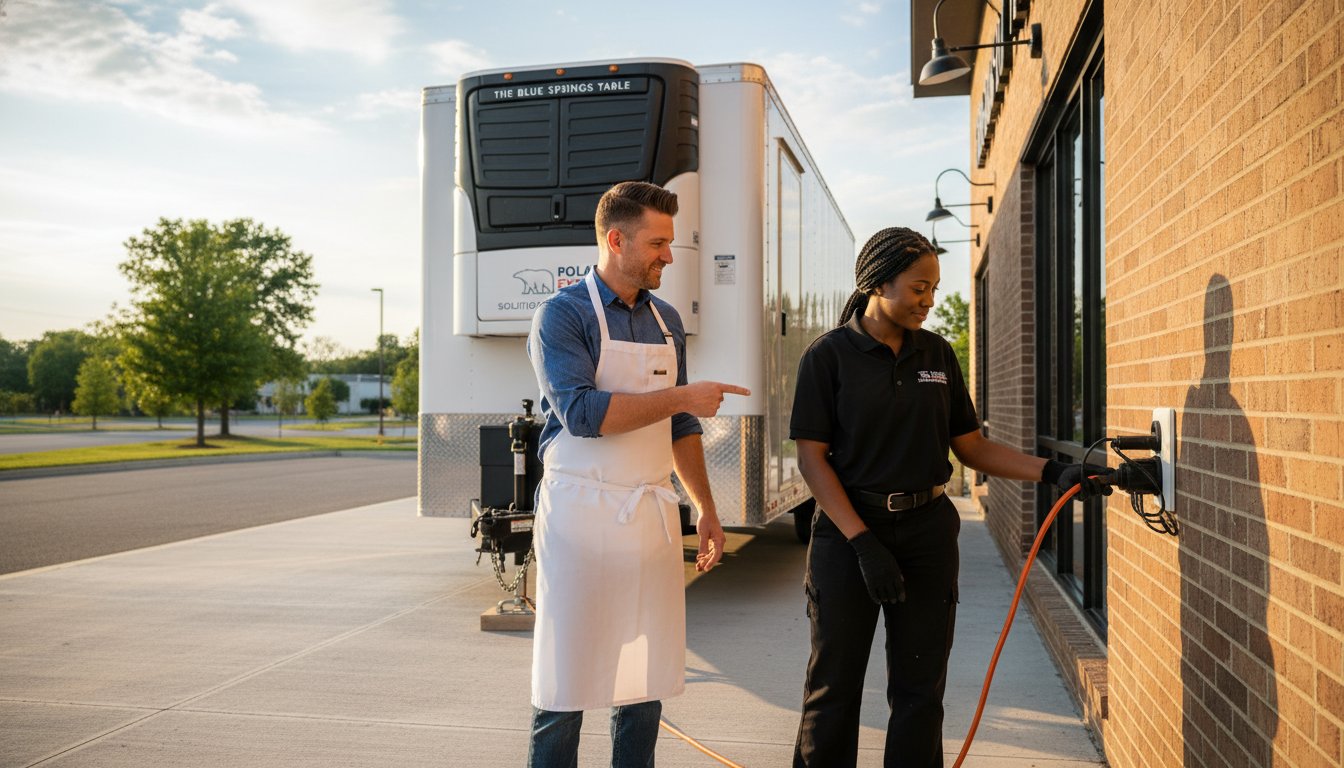
Power is another hurdle. Reefer trucks usually run on diesel or require specialized industrial plugs. A refrigerated trailer rental Kansas City typically runs on a standard 110v outlet. You don’t need an electrician or a fuel permit to get started. Plus, these units are designed for maneuverability. They fit into tight alleyways and parking spots where a semi-truck would simply get stuck. When every minute counts, you can’t afford to wait for a driver to navigate a complex parking lot.
The Limitations of Dry Ice and Generators
Many owners turn to dry ice in a panic. It works for small bins, but it is dangerous for walk-ins. Dry ice is frozen carbon dioxide. In an enclosed space, it can displace oxygen and create a lethal environment for your staff. You cannot safely work inside a cooler filled with CO2. It’s an invisible risk that isn’t worth the inventory it saves.
On-site generators seem like a great backup, but they come with high failure rates. They require constant fuel management. During a city-wide outage, finding a gas station with power becomes a mission of its own. Between the noise, the fumes, and the risk of the generator stalling, it’s a high-stress solution. A flat-rate rental for a mobile unit removes these variables. You get:
- Predictable costs without hidden fuel expenses.
- Quiet, fume-free operation near your building.
- Reliable 24/7 cooling that doesn’t depend on a gas tank.
It is the difference between a temporary fix and a professional continuity plan that actually works.
The First 60 Minutes: A Step-by-Step Response Checklist for Walk-In Failure
The first sixty minutes determine if you lose your inventory or save your sanity. When the alarm sounds, don’t call your insurance agent first. They can’t stop bacteria from growing. You need a logistical response that prioritizes your cold chain. A solid restaurant emergency plan refrigeration strategy starts with immediate, decisive action. This isn’t the time for a committee meeting; it’s the time for execution.
Verification and Containment
Start with a 30-second check. Is the power cord secure? Is the thermostat still set correctly? Check the breaker panel for a tripped switch. If the hardware isn’t the easy fix, pivot to containment. Grab a roll of Gaffer tape. Seal the door gaskets to create an airtight barrier. This simple step can buy you an extra 10% in thermal retention. While you do this, have a manager draft a “Limited Menu” notice for guests. Transparency keeps your customers on your side. It’s better to manage expectations early than to apologize for a warm salad later.
Securing Temporary Storage
Once containment is set, call for backup. You shouldn’t be searching for a provider while your walk-in is warming up. You need a pre-vetted partner on speed dial. Ask two critical questions: “How fast can you be here?” and “Is the unit ground-level?” Ground-level access is non-negotiable for a fast inventory move. It’s the difference between a smooth transition and a labor nightmare. For a deeper look at long-term planning, check out our Cold storage solutions for business: The 2026 Strategic Guide.
Your staff needs a leader, not a fellow panicker. Reassign roles immediately. One person handles documentation with timestamped photos of the thermometer. Another person preps the path to the loading area. A third team member starts the triage process we discussed earlier. This documentation is vital for future insurance claims or health inspections. It proves you followed your restaurant emergency plan refrigeration protocol to the letter. If you’re facing a crisis right now, secure a refrigerated trailer rental near Kansas City to keep your kitchen running without a hitch.
Documentation is your best friend during a crisis. Take clear, timestamped photos of every temperature reading. Record the exact time the failure was noticed and the time the backup unit arrived. This paper trail is essential for insurance adjusters who will look for any reason to deny a claim. It also provides peace of mind for health inspectors. It shows them that you took food safety seriously and didn’t leave your inventory to chance.
Implementing Your Plan with KC Frost Wagon’s Emergency Mobile Units
A plan is just paper until you have the equipment to back it up. You’ve done the triage and taped the doors. Now you need a place for those proteins to go. KC Frost Wagon is the final, most critical piece of your restaurant emergency plan refrigeration strategy. We don’t just rent trailers; we provide a bridge between a potential disaster and business as usual. Our team specializes in high-stakes logistics for the Kansas City metro area. Every minute your food sits in a warming walk-in, your profits evaporate. We stop that clock.
Our 24/7 Emergency Deployment Process
When you call our 24/7 emergency line, the clock starts for us too. We understand the layout of the city, from the tight alleys of the downtown KC core to the sprawling parking lots in Blue Springs. We don’t just drop a trailer and leave. We handle the delivery, the positioning, and the leveling. You focus on your kitchen while we handle the cold storage. For larger operations, our 6×16 freezer trailer for rent in Kansas City offers the massive capacity needed to save an entire walk-in’s worth of inventory. We also serve Independence and the surrounding areas with the same sense of urgency and speed.
Why KC Restaurants Trust the Frost Wagon
Why do local chefs trust us? It comes down to reliability and precision. Our units are clean, modern, and built for commercial intensity. These aren’t basic utility trailers. They are high-performance mobile units that maintain precise temperatures even in the middle of a Kansas heatwave. One of the biggest advantages is versatility. Our trailers can switch between cooler and freezer modes. If your deep-freeze fails in Olathe or your produce cooler goes down in Overland Park, we have the exact solution you need. You won’t have to worry about fluctuating temperatures or equipment failure on our watch.
We are part of this community. We aren’t a faceless national chain. We are your neighbors. We know the local health codes and the specific challenges of the KC climate. When you partner with us, you’re getting more than a rental. You’re getting a “Ready-for-Anything Expert” who takes the logistical burden off your shoulders. Your restaurant emergency plan refrigeration is only as strong as your fastest responder. Make sure that responder is a local hero who is just a phone call away. We handle the heavy lifting so you can stay focused on your customers.
Turn Your Refrigeration Crisis into a Logistics Win
A walk-in failure doesn’t have to mean a total loss. You now have the blueprint to fight back. By focusing on early detection and a 60-minute response checklist, you protect your profit margins and your brand. Remember that mobile trailers offer the ground-level access your team needs to move fast. Stop relying on luck or dangerous dry ice. Your restaurant emergency plan refrigeration strategy is only as strong as your backup cooling partner. You’ve seen how the right equipment makes the difference between a disaster and a minor detour.
KC Frost Wagon is ready to intervene. We provide 24/7 local emergency response across the entire Kansas City Metro. Our ground-level 6×16 units are clean, reliable, and ready to roll. Don’t wait for the temperature to hit the danger zone. We handle the delivery and the leveling so you can focus on your staff. Save your inventory now-Call KC Frost Wagon for 24/7 Emergency Service. We handle the heavy lifting so you can get back to what you do best. Stay cool, stay prepared, and keep your kitchen running.
Frequently Asked Questions
How long will food stay cold in a walk-in after it breaks?
Expect your walk-in to maintain safe temperatures for approximately four hours, provided the doors remain sealed. This window depends heavily on your inventory’s thermal mass and the outside temperature. In the intense Kansas City summer heat, that time can shrink quickly. Keeping the doors closed is your best defense while you wait for a backup unit to arrive on-site.
Does business interruption insurance cover refrigeration failure?
Coverage depends entirely on your specific policy and the “spoilage endorsement” you have selected. Many plans cover inventory loss if the failure resulted from a power outage or a mechanical breakdown. You should consult your agent to verify these details before a crisis hits. Always document the event with timestamped photos and temperature logs as part of your restaurant emergency plan refrigeration strategy to support future claims.
Can I run a mobile freezer trailer on a standard 110v outlet?
Yes, our mobile units are designed for maximum compatibility with standard restaurant infrastructure. You don’t need to hire an electrician for specialized industrial plugs or manage a loud, fume-heavy generator. A dedicated 110v, 20-amp circuit is usually all that’s required to keep your inventory frozen. This plug-and-play design allows for an immediate response when your primary system fails.
What is the fastest way to get emergency refrigeration in Kansas City?
The quickest solution is contacting a local provider that offers 24/7 emergency dispatch within the metro area. Local experts understand the layout of downtown and the surrounding suburbs, allowing them to navigate traffic and reach your loading dock faster than national chains. Having a reliable contact on speed dial ensures you aren’t wasting precious time searching for a rental while your food warms up.
How much dry ice do I need for a commercial walk-in cooler?
You should avoid using dry ice in a walk-in cooler because it creates significant safety risks. Calculating the correct amount for a large commercial space is difficult, and the resulting carbon dioxide buildup can be lethal for your staff. It’s much safer and more efficient to move your perishable inventory into a ground-level mobile cooler where your team can work in a ventilated, temperature-controlled environment.
What temperature should my emergency cooler be set to for food safety?
Set your emergency cooler to 38°F for refrigerated goods and 0°F or lower for frozen products. These settings provide a vital safety buffer below the 41°F “danger zone” required by most health departments. Maintaining these precise levels is a core component of a professional restaurant emergency plan refrigeration protocol. It ensures your inventory stays fresh and your business remains compliant with local health codes.
Is it better to rent a reefer truck or a cooler trailer?
A cooler trailer is generally the superior choice for restaurant environments. Reefer trucks are often too large for tight city parking lots and require a loading dock for access. Cooler trailers sit at ground level, which eliminates the need for heavy lifting and reduces the risk of staff injury. They also run quietly on standard electricity, making them less disruptive to your neighbors and guests.
What are the power requirements for a 6×16 mobile freezer?
A 6×16 mobile freezer typically requires a standard 110v outlet on a dedicated 20-amp circuit. We provide the heavy-duty extension cords needed to ensure a stable and safe power connection. This simple requirement means you can have the unit up and running almost anywhere on your property. It’s a reliable, low-hassle solution that lets you focus on managing your kitchen instead of worrying about electrical compatibility.





Leave A Comment